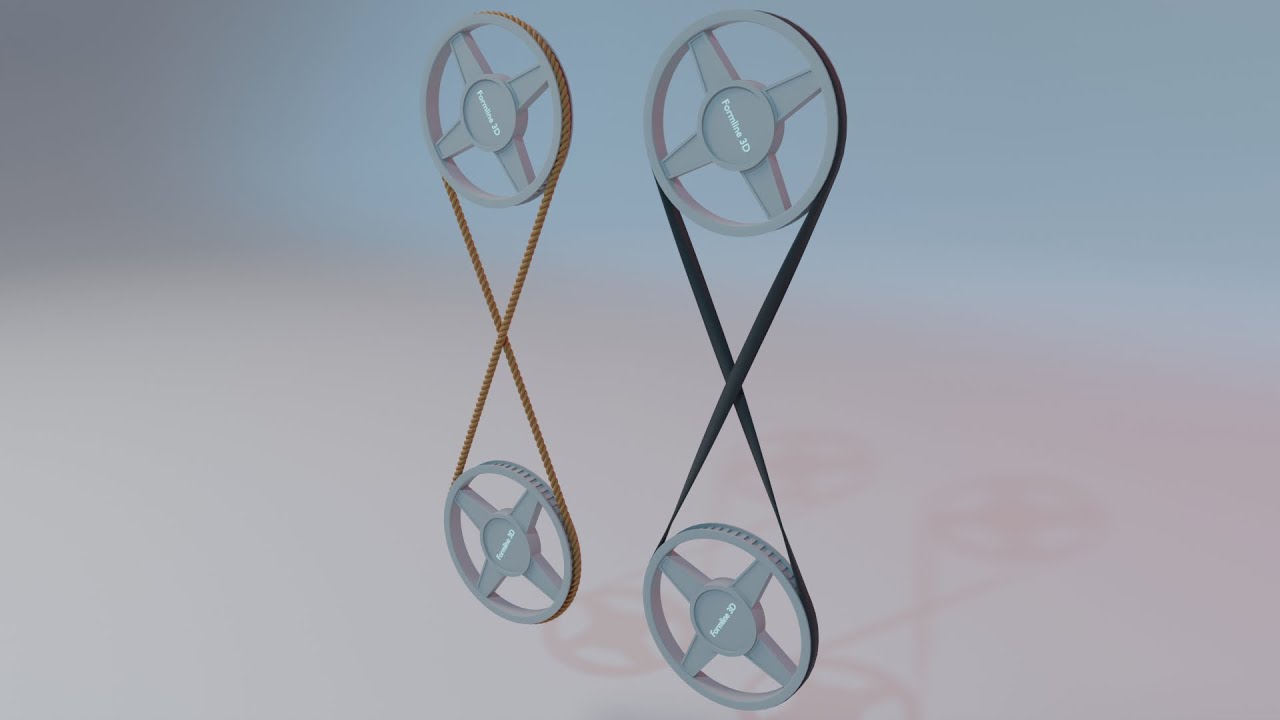
#009 Variable Speed Cone Pulleys – 507 Mechanical Movements 3D Animation

#009 Variable Speed Cone Pulleys – 507 Mechanical Movements 3D Animation

Thursday, Jan 22, 2026

Movement No. 9 presents one of the most practically significant variable speed transmission mechanisms in the history of mechanical engineering — the Cone Pulley system. Two opposing conical pulleys are mounted on parallel shafts, with their tapers arranged in mirror image: where one cone is wide, the other is narrow, and vice versa. A flat drive belt connects the two cones and can be shifted laterally along their length to any of several discrete positions. At each position, the belt contacts the two cones at different effective diameters — a large diameter on one and a correspondingly small diameter on the other — producing a specific speed ratio between the input and output shafts. By sliding the belt from one end of the cone pair toward the other, the operator can progressively increase or decrease the output speed in a series of steps, achieving what Henry T. Brown describes as a “gradually increased or diminished speed.” The speed ratio at any belt position is directly proportional to the ratio of the two effective contact diameters: if the driver cone contacts the belt at twice the diameter of the driven cone, the output shaft turns at twice the input speed, and vice versa. Henry T. Brown specifically highlights its use in cotton machinery — a reference to the textile mills of the Industrial Revolution, where precise and adjustable speed control was essential for spinning and weaving operations. The cone pulley remains a direct mechanical ancestor of the modern continuously variable transmission (CVT), and its stepped speed-change principle is still found today in drill presses, metal lathes, and milling machines worldwide.

@
2 minute read
#008 Stepped Pulley Speed Control – 507 Mechanical Movements 3D Animation

#008 Stepped Pulley Speed Control – 507 Mechanical Movements 3D Animation

Wednesday, Jan 21, 2026

Movement No. 8 presents the Variable Speed Stepped Pulley — one of the most widely used and practically important speed-control mechanisms in the history of machine tool design. The stepped pulley system consists of two matched pulley sets, each comprising multiple pulley stages of different diameters arranged in a staircase-like profile — hence the name “stepped pulleys.” The two sets are mounted on parallel shafts (typically the drive shaft and the machine spindle shaft), with their steps arranged in opposing order: where the driver pulley set has its largest step, the driven pulley set has its smallest, and vice versa. A single flat belt connects the two sets and can be manually shifted from one step to another, engaging a different pair of opposing diameters at each position. Each belt position produces a specific, fixed speed ratio determined by the diameter ratio of the engaged steps. With three steps on each pulley set, for example, three distinct output speeds are available — giving the machine operator the ability to select the most appropriate spindle speed for the material and cutting tool in use. Henry T. Brown specifically cites its application in lathes and other mechanical tools — a testament to the mechanism’s central importance during the Industrial Revolution, when precise speed selection was critical for turning wood, brass, iron, and steel to different finishes. Unlike the cone pulley of Movement No. 9, which allows the belt to be placed at any position along a continuous taper, the stepped pulley provides discrete, repeatable speed selections, making it simpler and more reliable for workshop environments. Stepped pulleys can still be found today in drill presses, bench lathes, and wood-turning equipment worldwide.

@
2 minute read
#007 Pulley Transmission – 507 Mechanical Movements 3D Animation

#007 Pulley Transmission – 507 Mechanical Movements 3D Animation

Tuesday, Jan 20, 2026

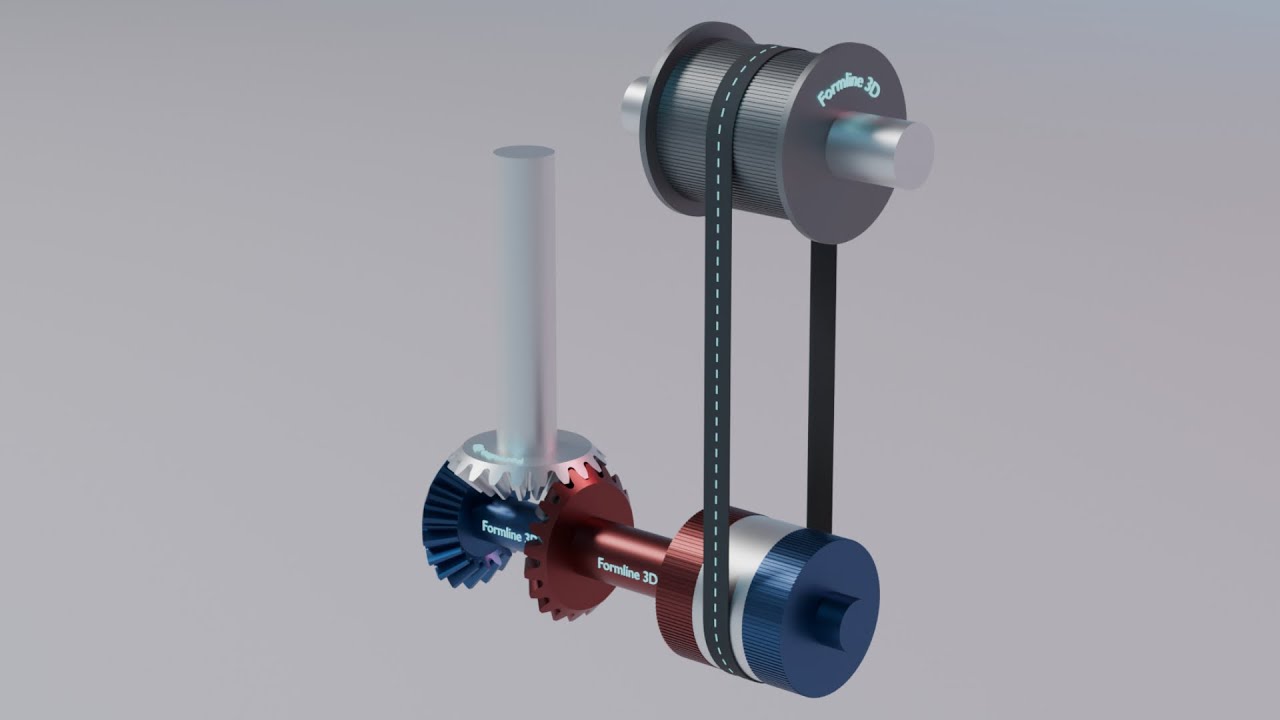
Movement No. 7 presents a brilliantly elegant mechanism for engaging, disengaging, and reversing an output shaft using nothing more than a shifting belt and a carefully arranged system of concentric shafts and bevel gears — with no friction clutch or complex reversing gearbox required. The mechanism operates through three distinct states controlled entirely by the lateral position of a single drive belt. At the heart of the system are two coaxial shafts: an outer hollow shaft, b, and an inner solid shaft, a, which runs concentrically inside it. Three pulleys sit side by side on the drive shaft — a left pulley fixed to the hollow shaft b (carrying bevel gear B), a center loose pulley that spins freely and transmits no motion, and a right pulley fixed to inner shaft a (connected to bevel gear A). When the belt rides on the center loose pulley, neither shaft turns — the system is disengaged and the output vertical shaft is stationary. When the belt is shifted left onto the pulley fixed to hollow shaft b, bevel gear B drives the upright output shaft in one direction. When the belt is shifted right onto the pulley fixed to inner shaft a, bevel gear A transmits drive to the upright shaft — but because shaft a and shaft b are concentric and their bevel gears mesh with the output shaft from different geometric arrangements, the direction of rotation of the output shaft is reversed. This gives the operator full three-state control — forward, neutral, and reverse — using only a belt shift lever. This mechanism was widely used in 19th-century machine tools, milling machines, and industrial equipment as a simple and reliable means of shaft direction control without stopping the prime mover.

@
2 minute read
#006 Pulleys with Vibrating Lever - 507 Mechanical Movements 3D Animation

#006 Pulleys with Vibrating Lever - 507 Mechanical Movements 3D Animation

Monday, Jan 19, 2026

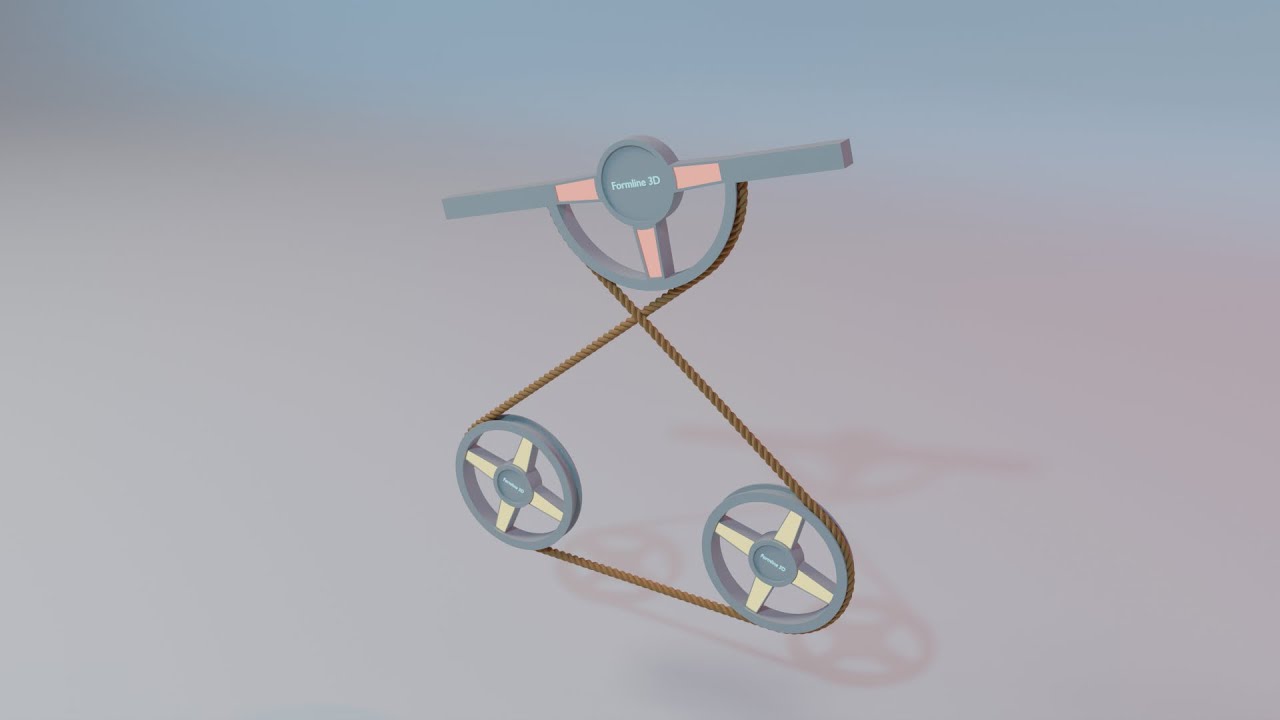
Movement No. 6 presents a fascinating mechanism for converting a simple back-and-forth vibratory motion into a reciprocating rotary motion — transmitted through a belt and a semi-circular segment to a pair of pulleys below. The heart of the mechanism is a semi-circular segment, essentially a half-disk or curved rack, to which a lever is rigidly attached. When the lever is pushed and pulled back and forth in a vibratory oscillating motion, the semi-circular segment rocks correspondingly about its central pivot. A belt is fixed to and wrapped around the curved outer edge of this semi-circular segment, so that as the segment rocks in one direction, the belt is paid out on one side and taken up on the other — alternately pulling and releasing the pulleys below in a reciprocating fashion. The two lower pulleys are consequently driven in alternating directions of rotation — spinning clockwise, then counter-clockwise, then clockwise again — in perfect synchrony with each swing of the lever above. This mechanism elegantly bridges the worlds of linear oscillating input and rotary output, making it particularly useful in applications where a rocking or vibratory prime mover — such as a hand lever, a foot treadle, or a cam-driven rocker arm — needs to drive a rotating load. The semi-circular geometry of the segment ensures smooth, continuous belt engagement throughout the arc of the vibratory stroke, and the mechanism can be scaled easily to suit the amplitude and frequency requirements of different applications. This type of motion conversion is found historically in treadle-powered lathes, hand-operated sewing machines, and early reciprocating pumps.

@
2 minute read
#005 Pulleys with Tightening Mechanism - 507 Mechanical Movements 3D Animation

#005 Pulleys with Tightening Mechanism - 507 Mechanical Movements 3D Animation

Sunday, Jan 18, 2026

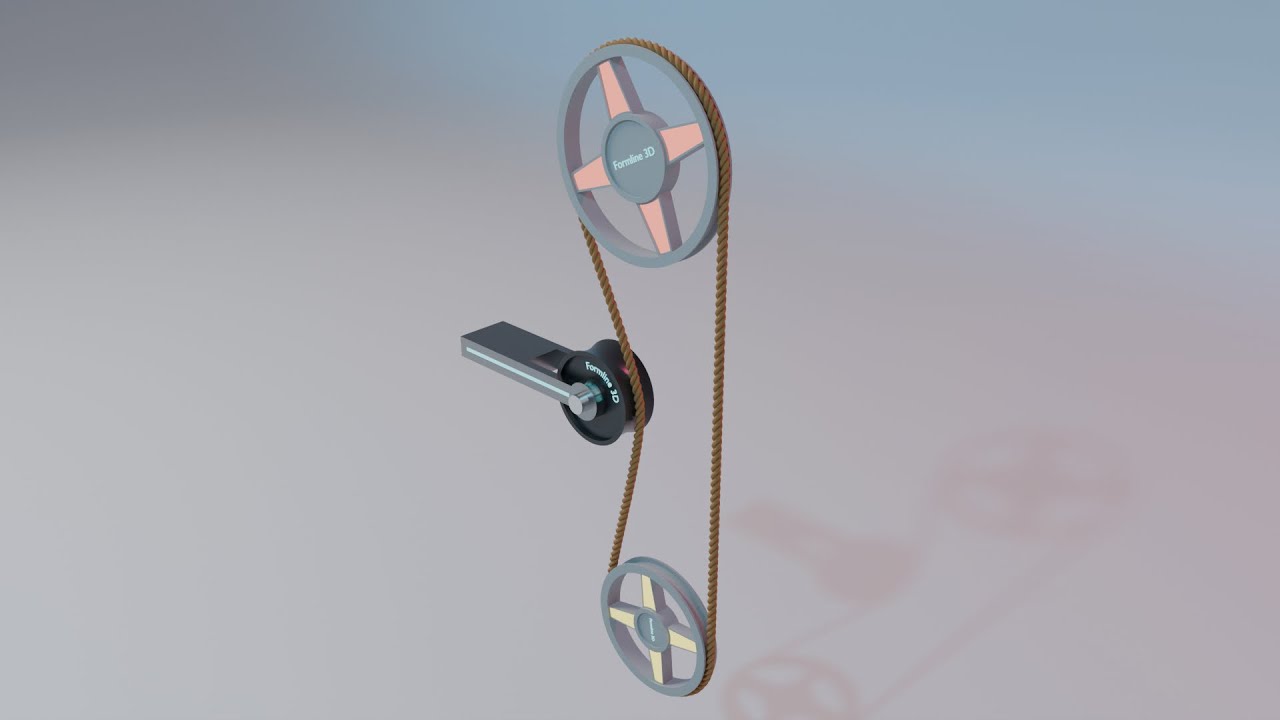
Movement No. 5 builds directly upon Movement No. 1 — the basic flat belt drive between two pulleys — by introducing one critically important addition: a movable tightening pulley, B, which acts as a belt clutch. In the basic configuration, a flat drive belt connects two larger pulleys on parallel shafts. However, the belt is intentionally made slightly slack — loose enough that when left untensioned, it slips freely over both pulleys without transmitting any rotational motion. This slack condition represents the disengaged or “neutral” state of the mechanism. The genius of the system lies in the tightening pulley B — a small idler pulley mounted on a movable arm or pivot. When pulley B is pressed inward against the slack belt, it takes up the excess slack, increasing the belt’s tension against both large pulleys and restoring sufficient friction for the belt to positively grip the driver pulley and transmit motion to the driven pulley. The mechanism is thereby engaged and power flows through the system. When pulley B is released and withdrawn, the belt returns to its slack condition and power transmission ceases immediately. This arrangement is one of the simplest and most reliable forms of belt clutch ever devised — it requires no complex interlocking components, produces no shock loads on engagement, and can be operated with minimal effort by pressing or releasing a lever connected to the tightening pulley arm. Henry T. Brown’s description captures this elegantly: the belt transmits motion when the pulley is pressed, and does not transmit when it is not. This fundamental mechanism is the direct precursor to the modern tensioner-clutch systems found in agricultural machinery, go-kart engines, garden equipment, and early industrial machine tools.

@
2 minute read
#004 Crossed-Belt Right-Angle Drive - 507 Mechanical Movements 3D Animation

#004 Crossed-Belt Right-Angle Drive - 507 Mechanical Movements 3D Animation

Saturday, Jan 17, 2026

Movement No. 4 presents an elegant solution to a specific geometric challenge in belt transmission: how to transmit rotational motion between two shafts that are oriented at right angles to each other, but whose axes lie within the same plane. This distinguishes it from Movements No. 3 and No. 11, where the shafts are perpendicular and their axes lie in different planes — requiring the belt to twist out of plane as it transitions between the two pulleys. In Movement No. 4, because both shaft axes share the same plane, the belt can remain entirely within that plane throughout its path — but the two pulleys must be mounted at 90 degrees to each other, with one pulley’s axis perpendicular to the other’s within the common plane. Henry T. Brown presents two possible belt configurations for this arrangement: an open belt and a crossed belt. While an open belt can be used, the crossed belt is specifically recommended as the preferred solution because it provides a greater arc of contact — the angle over which the belt wraps around each pulley — thereby increasing the total friction force available for power transmission and reducing the likelihood of belt slippage under load. The crossing of the belt also naturally causes the driven pulley to rotate in the opposite direction to the driver, which may be advantageous or easily accommodated depending on the application. This mechanism provides a compact, gearless solution for changing the direction of a drive axis by 90 degrees within a single plane, and was widely used in mill machinery, agricultural equipment, and workshop tools where a simple direction change was needed without resorting to bevel gears or complex intermediate shafting.

@
2 minute read
#003 Right-Angle Belt Drive - 507 Mechanical Movements 3D Animation

#003 Right-Angle Belt Drive - 507 Mechanical Movements 3D Animation

Saturday, Jan 17, 2026

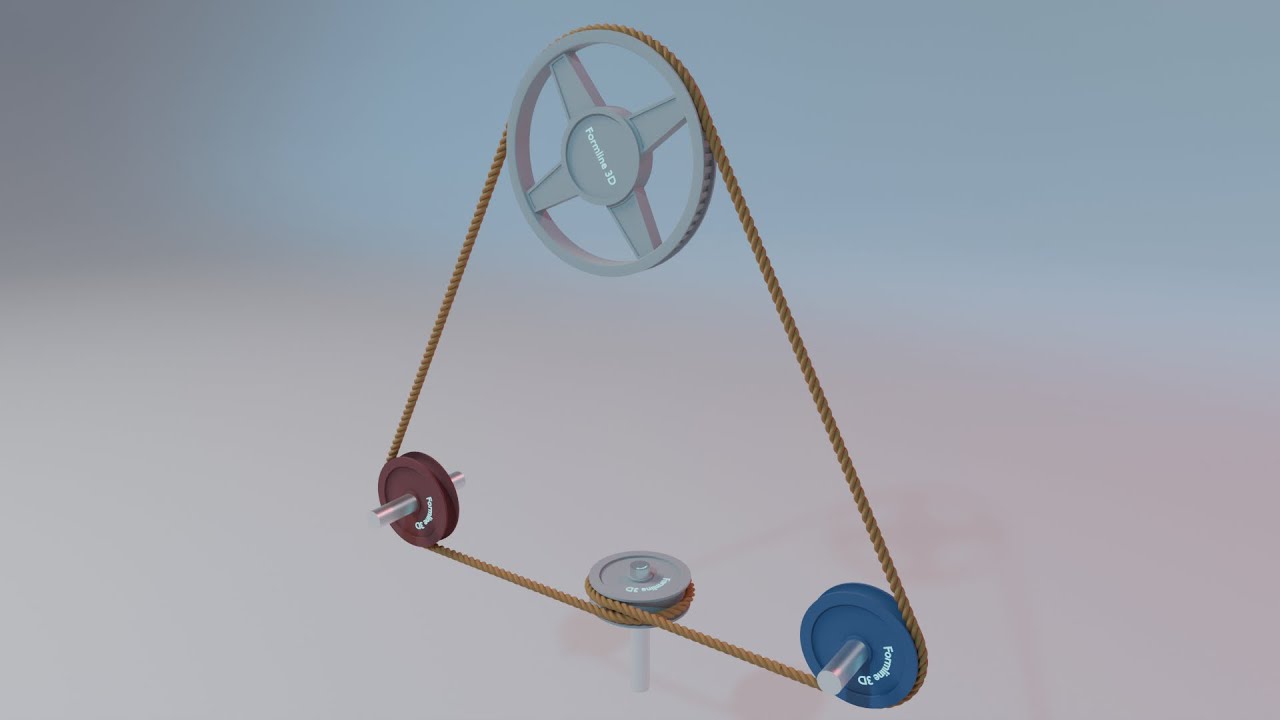
Movement No. 3 presents a classic engineering solution for transmitting rotational motion between two shafts oriented at right angles to each other — where the shaft axes do not lie in the same plane — using a pair of guide pulleys and a split belt. The central challenge of transmitting power between two perpendicular shafts via a belt is that the belt must transition from one plane of rotation to a completely different plane, rotating 90 degrees between the two pulleys. Without guidance, a flat belt attempting this transition would twist unevenly, run off the pulleys, and fail to transmit power reliably. Movement No. 3 solves this problem with an ingenious but simple solution: the drive belt is split into two separate leaves — essentially two narrow belts running side by side — and two guide pulleys are positioned at the transition point, mounted side by side on a common axle, one for each leaf of the belt. Each leaf of the split belt wraps around its own dedicated guide pulley, which redirects it smoothly and independently through the required 90-degree transition. By splitting the belt and providing individual guidance for each half, the mechanism ensures that the belt transitions cleanly and evenly between the two perpendicular shaft planes without twisting or running unevenly. The two guide pulleys work together as a pair to collectively redirect the full drive force of the belt system around the right angle. This mechanism is a direct mechanical precursor to the quarter-turn belt arrangement seen in No. 11, which achieves the same result without any guide pulleys by exploiting belt geometry alone — making the comparison between No. 3 and No. 11 a particularly instructive study in engineering design trade-offs between simplicity and reliability.

@
2 minute read
#002 Cross Belt Drive - 507 Mechanical Movements 3D Animation

#002 Cross Belt Drive - 507 Mechanical Movements 3D Animation

Friday, Jan 16, 2026

Movement No. 2 builds directly upon Movement No. 1 — the simple open belt drive — by introducing the crossed belt configuration and, in doing so, unlocking one of the most practically powerful features in classical belt transmission: the ability to reverse the direction of the driven shaft without stopping or reversing the driving motor. In its simplest form, replacing the open belt of No. 1 with a crossed belt — where the belt forms an X shape between the two pulleys — reverses the direction of rotation of the driven pulley relative to the driver. With an open belt, both pulleys rotate in the same direction; with a crossed belt, they rotate in opposite directions. But Movement No. 2 goes further, describing an elegant three-pulley reversing mechanism: three pulleys are mounted side by side on the driven shaft — the center pulley is fixed (keyed) to the shaft, while the two outer pulleys are loose (they spin freely on the shaft without driving it). Two belts are used simultaneously — one open belt and one crossed belt — each connecting the driver to one of the three driven-side pulleys. At any moment, one belt rides on the fixed center pulley (driving the shaft), while the other rides on a loose outer pulley (spinning freely, doing nothing). By shifting both belts simultaneously — moving the active belt from the center fast pulley to a loose pulley, while moving the idle belt from a loose pulley to the center fast pulley — the shaft direction is instantly reversed, all while the driving motor continues running at full speed without interruption. This elegant and reliable direction-reversing mechanism was widely used in 19th-century machine tools, lathes, milling machines, and early industrial equipment, and represents a foundational principle of mechanical power control that predates electrical motor reversing by many decades.

@
2 minute read
#001 Open Belt Drive - 507 Mechanical Movements 3D Animation

#001 Open Belt Drive - 507 Mechanical Movements 3D Animation

Wednesday, Jan 14, 2026

Movement No. 1 is the very first entry in Henry T. Brown’s landmark 1868 reference work — and fittingly, it presents the most fundamental and universally important mechanism in the entire field of mechanical power transmission: the simple open belt and pulley drive. Two pulleys of equal or different diameters are mounted on separate parallel shafts, connected by a continuous flat belt that runs in a straight, uncrossed path between them — forming what is known as an open belt configuration. As the driver pulley rotates, friction between the belt and pulley surfaces causes the belt to move, which in turn drives the second pulley by the same frictional engagement on the other end. The defining characteristic of the open belt configuration, stated precisely by Henry T. Brown, is that both pulleys rotate in the same direction — if the driver turns clockwise, the driven pulley also turns clockwise. The speed ratio between the two pulleys is determined purely by the inverse ratio of their diameters: a driven pulley with half the diameter of the driver will rotate at twice the speed, while one with twice the diameter will rotate at half the speed. The torque ratio follows the inverse relationship. Power is transmitted entirely through friction between the belt and pulley surfaces — no teeth, no rigid connections, no direct contact between the shafts. This frictional nature provides a natural overload protection: under excessive load, the belt slips rather than breaking the machinery. The open belt and pulley is the ancestor of every belt-driven machine ever built — from the great line-shaft mills of the Industrial Revolution to modern serpentine belt systems in automobile engines, V-belt drives in HVAC equipment, and conveyor systems worldwide. It is the logical and historical starting point for the entire 507 Mechanical Movements collection.

@
2 minute read

© 2026 Formline 3D Mechanisms

Powered by Formline 3D

Formline 3D

Formline 3D is a 3D animation channel exploring the form, structure, and design of the world around us.

From everyday objects to complex machines, we use Blender and real-time graphics to visualize how things are built, how they work, and how their shapes come together.

No talking heads. No stock footage. Just carefully crafted 3D animations that turn objects, technology, and ideas into clear visual stories.

If you love design, engineering, products, or simply understanding how things are made — you’re in the right place.