This mechanism shows a reversing-gear used to change the direction of rotation of a single steam engine. When the eccentric-rod is raised, the valve-spindle is released from the eccentric. The engine can then be manually reversed by operating the upright lever. Once the direction has changed, the eccentric-rod is lowered again to re-engage the valve gear.
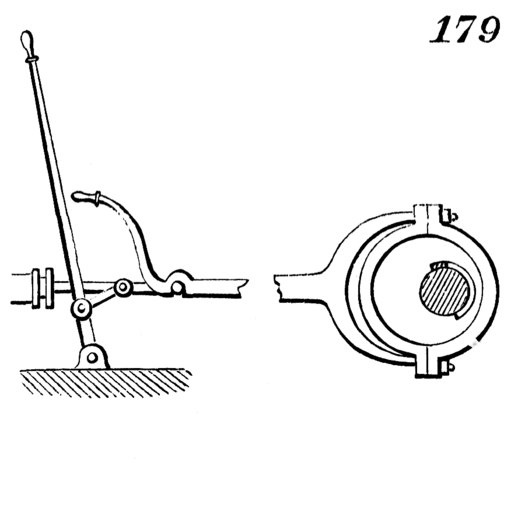
179. Reversing-gear for a single engine. On raising the eccentric-rod the valve-spindle is released. The engine can then be reversed by working the upright lever, after which the eccentric-rod is let down again. The eccentric in this case is loose upon the shaft and driven by a projection on the shaft acting upon a nearly semi-circular projection on the side of the eccentric, which permits the eccentric to turn half-way round on the shaft on reversing the valves.
The eccentric itself is not fixed to the shaft — it sits loosely upon it. A projection on the shaft drives the eccentric by pushing against a nearly semi-circular projection on the side of the eccentric. This loose-fit design allows the eccentric to rotate half a turn relative to the shaft, which is exactly what’s needed to reverse the valve motion — and therefore the direction of the engine.