Movement No. 176 & 177 demonstrate an engine uncoupling contrivance that allows a crank to be selectively engaged or disengaged from its drive using a rotatable slotted ring. A wrist pin, fixed to one arm of a driving crank, interacts with a slotted ring mounted on a second, driven crank arm. When the ring’s slot is oriented to intercept the wrist pin’s circular path (No. 176 — engaged position), the pin pushes against the sides of the slot as it travels, transmitting rotary motion and turning the driven crank along with the driving crank. When the ring is rotated to bring the slot into alignment with the wrist pin’s path (No. 177 — disengaged position), the pin passes freely through the slot without contact, allowing the driving crank to rotate while leaving the driven crank stationary. This simple ring-rotation mechanism allows instant coupling or uncoupling of an engine from its driven shaft, without the need for a separate clutch, making it particularly useful for isolating engines during maintenance, startup, or multi-engine operations.
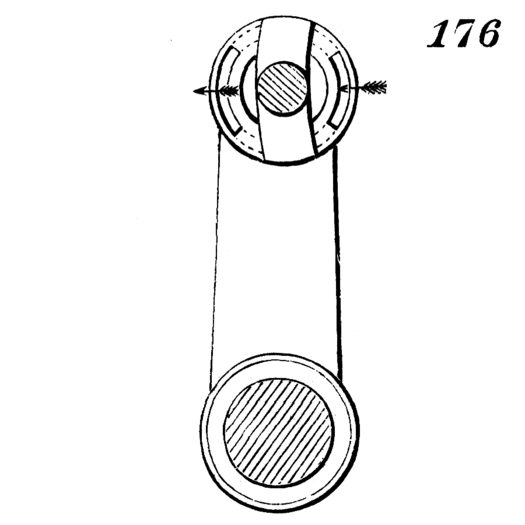
176 and 177. Contrivance for uncoupling engines. The wrist which is fixed on one arm of the crank (not shown) will communicate motion to the arm of the crank which is represented, when the ring on the latter has its slot in the position shown in 176. But when the ring is turned to bring the slot in the position shown in 177, the wrist passes through the slot without turning the crank to which said ring is attached.