Movement No. 173 demonstrates an alternative mechanism for varying the traverse stroke of a silk guide-rod, serving the same purpose as Movement No. 142 but through a different approach using a screw and tappet-wheel. A screw is fixed to the back of a rotating disk or bevel-gear, with a tappet-wheel mounted at one end of the screw. As the disk completes each revolution, the tappet-wheel strikes a fixed pin or tappet, causing the screw to receive a small intermittent rotation. A wrist (crank pin) attached to a nut threaded on the screw rides inside a slotted bar at the end of the guide-rod. Because each revolution of the disk incrementally turns the screw via the tappet contact, the nut’s position along the screw gradually shifts — changing the effective crank radius of the wrist and therefore the stroke length of the guide-rod. This progressive stroke variation builds up evenly tapered silk layers on the bobbin as it winds, achieving the same functional goal as the differential gear arrangement in No. 142 through a simpler screw-and-tappet design.
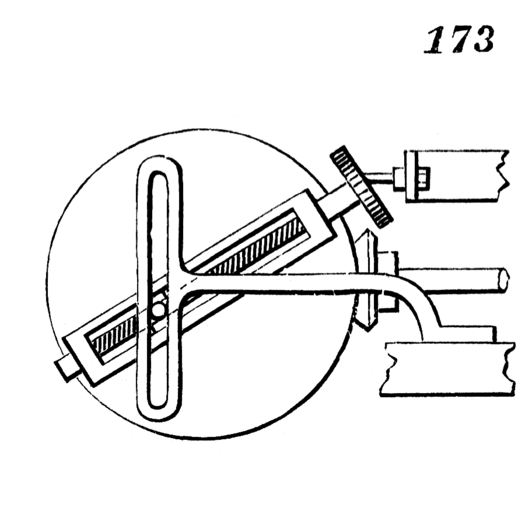
173. A movement used in silk machinery for the same purpose as that described in 142. On the back of a disk or bevel-gear is secured a screw with a tappet-wheel at one extremity. On each revolution of the disk the tappet-wheel comes in contact with a pin or tappet, and thus receives an intermittent rotary movement. A wrist secured to a nut on the screw enters and works in a slotted bar at the end of the rod which guides the silk on the bobbins. Each revolution of the disk varies the length of stroke of the guide-rod, as the tappet-wheel on the end of the screw turns the screw with it, and the position of the nut on the screw is therefore changed.