Movement No. 171 demonstrates the valve motion and reversing gear used in oscillating marine steam engines — a sophisticated mechanism closely related to the Stephenson link motion used in locomotives. Two eccentrics, mounted on the crankshaft at different angular positions, drive two eccentric rods that connect to opposite ends of a slotted curved link. As the crankshaft turns, the two eccentric rods impart an oscillating motion to the curved link, swinging it back and forth over the engine’s trunnion. A pin, attached to the arm of a rock-shaft, rides inside the curved slot of the link. As the link swings, the pin is driven back and forth, rocking the rock-shaft and operating the valve. The curved slot is an arc centered on the trunnion, ensuring the valve motion is unaffected by the cylinder’s own oscillation. By shifting the pin to different positions along the slot — toward one eccentric or the other — the valve timing and direction of engine rotation can be reversed, providing full forward and reverse control for marine propulsion.
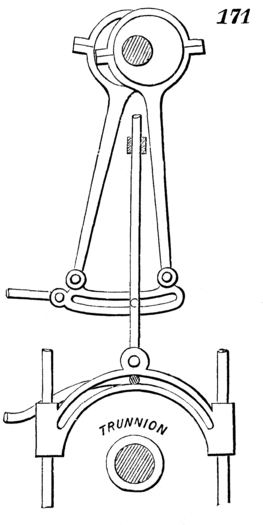
171. Valve motion and reversing gear used in oscillating marine engines. The two eccentric rods give an oscillating motion to the slotted link which works the curved slide over the trunnion. Within the slot in the curved slide is a pin attached to the arm of a rock-shaft which gives motion to the valve. The curve of the slot in the slide is an arc of a circle described from the center of the trunnion, and as it moves with the cylinder it does not interfere with the stroke of the valve. The two eccentrics and link are like those of the link motion used in locomotives.