Movement No. 168 demonstrates an advanced crank mechanism that uses a slotted crank and a secondary fixed-radius crank to force the pitman’s end pin into an elliptical orbit, optimizing power transmission from a reciprocating engine. The slotted crank on the main engine shaft has a slot along its arm. A pitman (connecting-rod) has a pin at one end that rides in this slot. Between the main shaft and the reciprocating power source, an intermediate shaft carries a second crank of fixed radius, also connected to the same pitman. As the main slotted crank rotates in a circular orbit, the constraint of the second fixed-radius crank forces the pitman’s pin to trace an elliptical path rather than a simple circle. This elliptical orbit increases the effective leverage of the main crank precisely at the angular positions where the engine’s reciprocating force is greatest — maximizing the mechanical advantage at the most favorable moments in the cycle and improving overall power transmission efficiency. This mechanism represents an early attempt at optimizing crank geometry for steam engine performance.
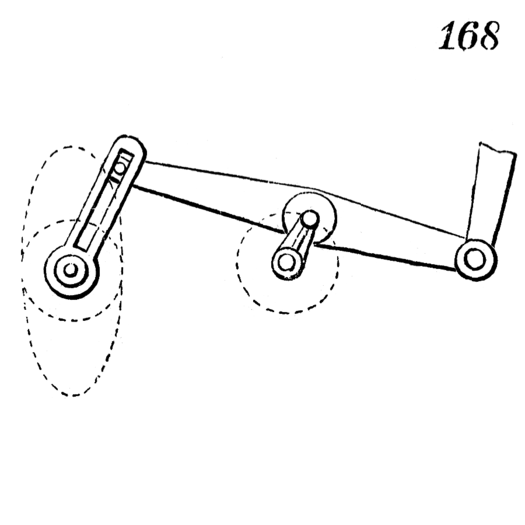
168. The slotted crank at the left hand of the figure is on the main shaft of an engine, and the pitman which connects it with the reciprocating moving power is furnished with a pin which works in the slot of the crank. Intermediate between the first crank and the moving power is a shaft carrying a second crank, of an invariable radius, connected with the same pitman. While the first crank moves in a circular orbit, the pin at the end of the pitman is compelled to move in an elliptical orbit, thereby increasing the leverage of the main crank at those points which are most favorable for the transmission of power.