Movement No. 167 demonstrates a spiral groove drum mechanism that converts reciprocating rectilinear motion into continuous rotary motion — serving as a substitute for the crank in steam engines. A drum or cylinder is cut with an endless spiral groove that wraps all the way around its surface. Crucially, the groove is divided into two halves: one half spirals in one direction (say, left-hand), and the other half spirals in the opposite direction (right-hand). The two halves meet seamlessly at each end of the drum. A stud fixed to a reciprocating rod rides inside this groove. As the rod moves forward, the stud follows the forward-pitch groove and rotates the drum in one direction. When the rod reverses, the stud smoothly transitions into the reverse-pitch section of the groove and continues rotating the drum in the same direction. The result is continuous, unidirectional rotation of the drum from a simple back-and-forth linear input — an elegant crank substitute that transmits force along the axis of the rod rather than perpendicular to it.
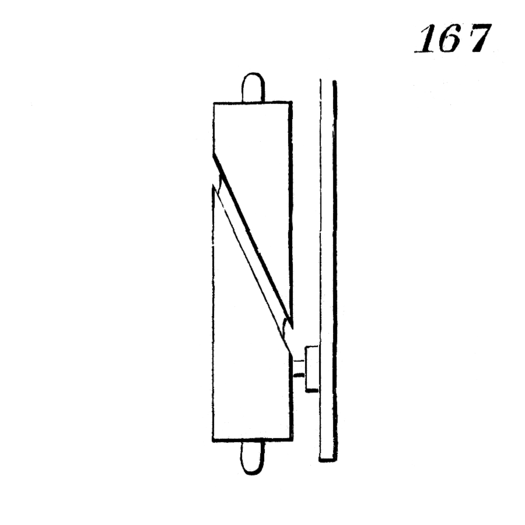
167. A drum or cylinder having an endless spiral groove extending all around it; one half of the groove having its pitch in one, and the other half its pitch in the opposite direction. A stud on a reciprocating rectilinearly moving rod works in the groove, and so converts reciprocating into rotary motion. This has been used as a substitute for the crank in a steam engine.