Movement No. 166 demonstrates a “lost motion” mechanism used in brick presses, where a slotted connecting-rod allows the mold to dwell at rest at the end of each stroke. A continuously rotating disk carries a crank-pin that drives a connecting-rod back and forth. However, the connecting-rod has a slot cut along part of its length, and the crank-pin rides within this slot. As the disk rotates, the crank-pin first traverses the length of the slot without moving the rod — this is the “lost motion” phase, during which the mold remains stationary. Once the pin reaches the end of the slot, it begins to push the rod, moving the mold to the other position. The mold then dwells again while the pin traverses back through the slot. This dwell-at-each-end behavior was perfectly suited to brick-press operation: the mold rests long enough for workers to deposit raw clay on one end and extract finished bricks on the other, all while the disk rotates continuously without stopping.
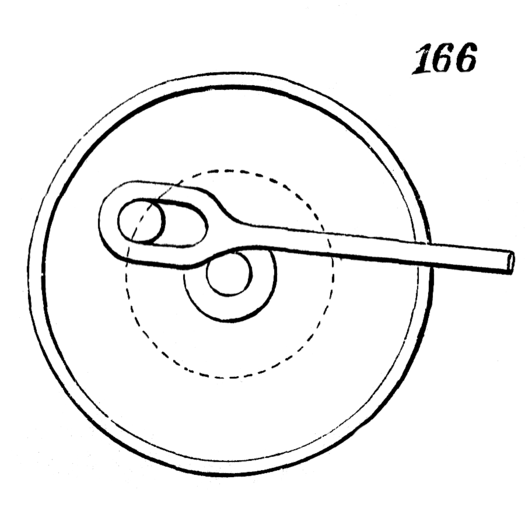
166. The rotation of the disk carrying the crank pin gives a to-and-fro motion to the connecting-rod, and the slot allows the rod to remain at rest at the termination of each stroke; it has been used in a brick-press, in which the connecting-rod draws a mold backward and forward, and permits it to rest at the termination of each stroke, that the clay may be deposited in it and the brick extracted.