Movement No. 165 converts circular motion of an upright shaft into rectilinear motion of an upright bar, using a waved-wheel (or cam) and an oscillating rod as the intermediate elements. A waved-wheel — a disk or wheel whose rim is formed with undulating waves or lobes — is mounted on the rotating upright shaft. An oscillating rod rests against or is held in contact with the waved surface of the wheel. As the shaft rotates, the successive waves or lobes of the wheel push the oscillating rod back and forth, causing it to swing about its pivot. This oscillating motion of the rod is then transferred to an upright bar, driving it up and down in rectilinear motion. The number and shape of the waves on the wheel determine the frequency and character of the bar’s reciprocating motion — more waves produce more strokes per revolution, while the wave profile controls the speed and dwell of each stroke. This mechanism is useful in applications requiring multiple linear strokes per shaft revolution with a compact and simple arrangement.
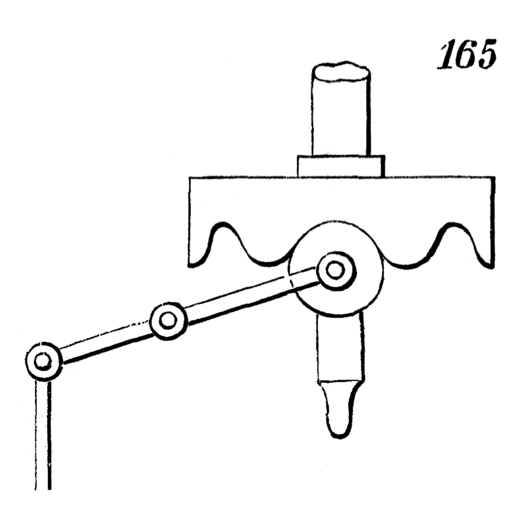
165. Circular into rectilinear motion. The waved-wheel or cam on the upright shaft communicates a rectilinear motion to the upright bar through the oscillating rod.