Movement No. 164 demonstrates the knee-lever — a close relative of the toggle-joint (No. 140) — widely used in presses and stamping machines for generating very large forces from modest input effort. The mechanism consists of two links connected at a central knee joint, with the upper end fixed and the lower end attached to the press ram or platen. A horizontal lever acts on the central knee joint: raising or lowering the lever pushes the knee joint sideways, causing the two links to straighten or bend. As the links approach a straight-line alignment, the mechanical advantage increases dramatically — a small horizontal force on the lever produces an enormous vertical force at the ram. This force-multiplying property near the straight position makes the knee-lever ideal for punching, coining, embossing, and any pressing operation requiring high force at the end of the stroke. Compared to No. 140, the knee-lever has a slightly different geometric arrangement that may offer different force and stroke characteristics depending on the application.
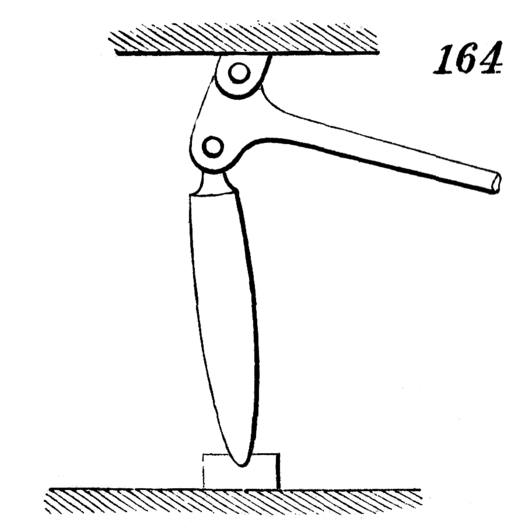
164. A knee-lever, differing slightly from the toggle-joint shown in 140. It is often used for presses and stamps, as a great force can be obtained by it. The action is by raising or lowering the horizontal lever.