Movement No. 163 presents another centrifugal governor arrangement for water-wheel speed control, using a three-pulley belt-shifting mechanism instead of the bevel-gear clutch of No. 162. Three pulleys are stacked on the governor spindle: the middle pulley is loose (freewheeling) on the spindle, while the upper and lower pulleys are fixed to it and rotate with it. A drive belt normally runs on the middle loose pulley — meaning no power is transmitted to the gate mechanism. As the balls rise or fall with changing speed, a cranked lever shifts the belt sideways onto either the upper or lower fixed pulley. When speed increases, the belt shifts to the lower fixed pulley, engaging gearing that raises the water gate and reduces water flow, slowing the wheel. When speed decreases, the belt shifts to the upper fixed pulley, engaging gearing in the opposite direction to lower the gate and increase water supply. This belt-shifting governor is mechanically elegant in its simplicity, using the position of the centrifugal balls to directly select the direction of gate control.
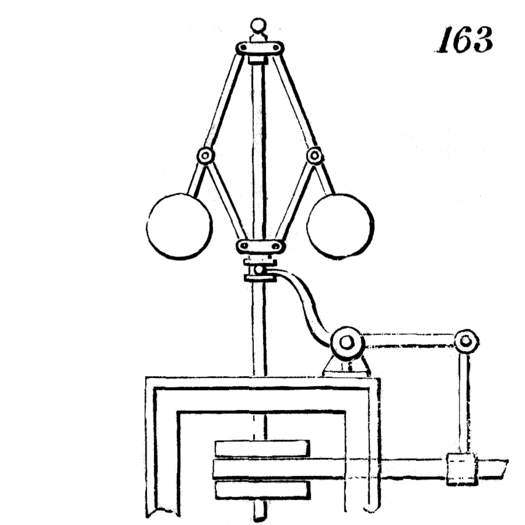
163. Another arrangement for a water-wheel governor. In this the governor controls the shuttle or gate by means of the cranked lever, which acts on the strap or belt in the following manner:-The belt runs on one of three pulleys, the middle one of which is loose on the governor spindle and the upper and lower ones fast. When the governor is running at the proper speed the belt is on the loose pulley, as shown; but when the speed increases the belt is thrown on the lower pulley, and thereby caused to act upon suitable gearing for raising the gate or shuttle and decreasing the supply of water. A reduction of the speed of the governor brings the belt on the upper pulley, which acts upon gearing for producing an opposite effect on the shuttle or gate.