Movement No. 162 demonstrates a centrifugal ball governor adapted for controlling a water-wheel, operating on the same feedback principle as No. 161 but using a more sophisticated bevel-gear clutch mechanism to control a water gate. The governor spindle is driven by a top horizontal shaft through bevel-gears, causing the balls to fly outward at normal operating speed. Two bevel-gears on the lower spindle sit loosely — they do not rotate with the spindle under normal conditions. Each gear carries a stud. A pin attached to a sliding sleeve on the spindle rises or falls as the balls move in or out. When speed increases, the balls fly out and raise the pin sleeve upward, engaging the stud on the upper bevel-gear — causing it to rotate with the spindle and drive the lower horizontal shaft in a direction that raises the water gate, reducing water flow and slowing the wheel. When speed drops, the pin falls and engages the lower bevel-gear instead, driving the shaft in reverse to lower the gate and increase water flow. This elegant dual-clutch governor maintains precise water-wheel speed automatically.
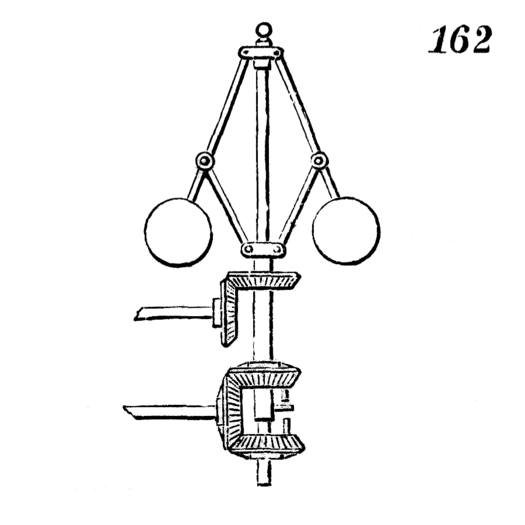
162. Water-wheel governor acting on the same principle as 161, but by different means. The governor is driven by the top horizontal shaft and bevel-gears, and the lower gears control the rise and fall of the shuttle or gate over or through which the water flows to the wheel. The action is as follows:-The two bevel-gears on the lower part of the center spindle, which are furnished with studs, are fitted loosely to the said spindle and remain at rest so long as the governor has a proper velocity; but immediately that the velocity increases, the balls, flying further out, draw up the pin which is attached to a loose sleeve which slides up and down the spindle, and this pin, coming in contact with the stud on the upper bevel gear, causes that gear to rotate with the spindle and to give motion to the lower horizontal shaft in such a direction as to make it raise the shuttle or gate, and so reduce the quantity of water passing to the wheel. On the contrary, if the speed ot the governor decreases below that required, the pin falls and gives motion to the lower bevel-gear, which drives the horizontal shaft in the opposite direction and produces a contrary effect.