Movement No. 161 demonstrates the centrifugal ball governor — one of the most celebrated automatic control devices in engineering history, famously associated with James Watt’s steam engine. The central spindle is driven by the engine through bevel-gears at the top, causing it to rotate at a speed proportional to engine speed. Two arms hang from the spindle, each carrying a heavy ball at its end. As the spindle rotates, centrifugal force causes the balls to swing outward from the center. The faster the engine runs, the further the balls fly out. As the balls move outward, their arms lift a slide connected by linkages to the regulating valve of the engine — partially closing the valve and reducing steam flow, which slows the engine back down. If engine speed drops, the balls fall inward, lowering the slide and opening the valve further to admit more steam. This elegant negative feedback loop automatically maintains a stable engine speed regardless of load changes, making it one of the earliest examples of automatic feedback control in engineering.
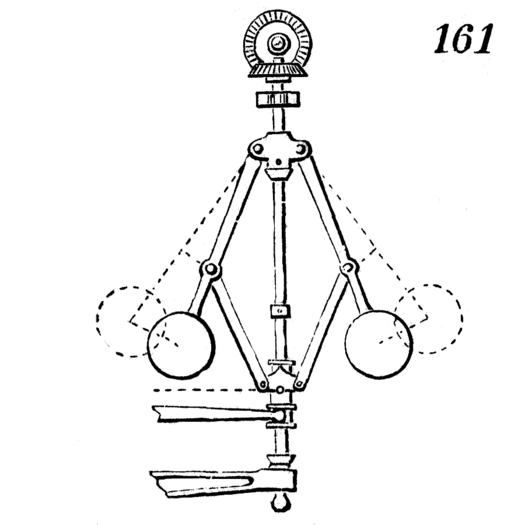
161. Centrifugal governor for steam engines. The central spindle and attached arms and balls are driven from the engine by the bevel-gears at the top, and the balls fly out from the center by centrifugal force. If the speed of the engine increases, the balls fly out further from the center, and so raise the slide at the bottom and thereby reduce the opening of the regulating-valve which is connected with said slide. A diminution of speed produces an opposite effect.