Movement No. 160 converts the alternating curvilinear motion of a spring-assisted treadle into alternating circular motion of a pulley. The operator presses the treadle down with their foot, and a spring mounted at the top automatically elevates the treadle back up for the next stroke. A connecting band — a flexible cord or strap — is wrapped once around the pulley and attached to the treadle. As the treadle descends, it pulls the band, which rotates the pulley in one direction. As the spring lifts the treadle back up, the band is slackened or pulled in reverse, rotating the pulley in the opposite direction. This produces an alternating (back-and-forth) rotation of the pulley rather than continuous one-directional rotation. The spring-return mechanism eliminates the need for the operator to actively lift the treadle, reducing fatigue and enabling a faster, more rhythmic operating cadence. This design was commonly used in early hand-powered tools and small workshop machinery.
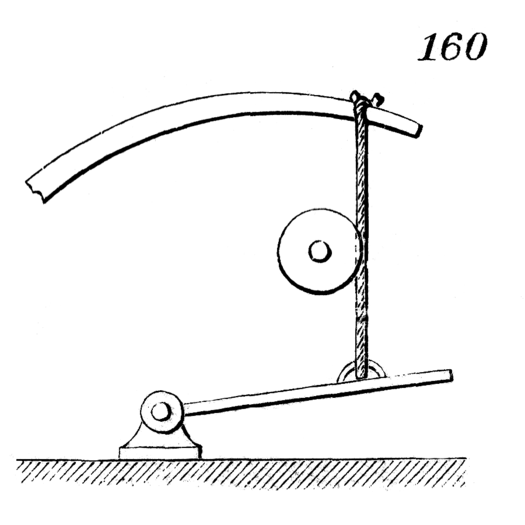
160. Alternating curvilinear motion into alternating circular. When the treadle has been depressed, the spring at the top elevates it for the next stroke; the connecting band passes once round the pulley, to which it gives motion.