Movement No. 158 demonstrates how the reciprocating curvilinear motion of a foot treadle is converted into continuous circular motion of a disk — the classic principle behind foot-powered machinery. The treadle is pivoted at one end and pressed down repeatedly by the operator’s foot, tracing a curved arc with each stroke. A connecting-rod links the treadle to a crank-pin on the rotating disk. As the treadle moves down, it pushes the connecting-rod which drives the disk through a partial rotation. The flywheel effect of the disk (or a separate flywheel) carries the rotation past top and bottom dead-center, allowing the treadle’s return stroke to continue driving the disk in the same direction. A crank arm can be substituted for the disk, performing identically in principle. This fundamental treadle-to-rotation mechanism was the driving force behind foot-powered lathes, sewing machines, grinding wheels, and early woodworking tools, forming the backbone of pre-industrial hand-powered manufacturing.
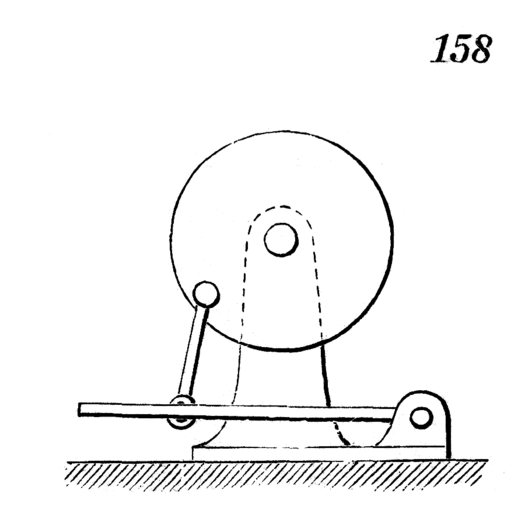
158. Reciprocating curvilinear motion of the treadle gives a circular motion to the disk. A crank may be substituted for the disk.