Movement No. 152 demonstrates the ellipsograph — also known as the Trammel of Archimedes — a beautifully simple mechanism that traces a perfect ellipse. A cross-piece provides two perpendicular grooves — one horizontal and one vertical. A traverse bar carries two studs spaced apart along its length, each constrained to slide within one of the grooves. As the traverse bar is rotated, each stud is forced to move back and forth in its respective groove in a purely rectilinear motion. The combined constraint of both studs causes any point fixed on the traverse bar — such as a pencil or marking point at the end — to trace a perfect ellipse. The size and proportions of the ellipse are determined by the spacing of the two studs along the bar: the semi-axes of the ellipse equal the distances from the pencil point to each stud respectively. This mechanism is the mechanical embodiment of the geometric definition of an ellipse and has been used for centuries in engineering drawing, woodworking, and decorative arts.
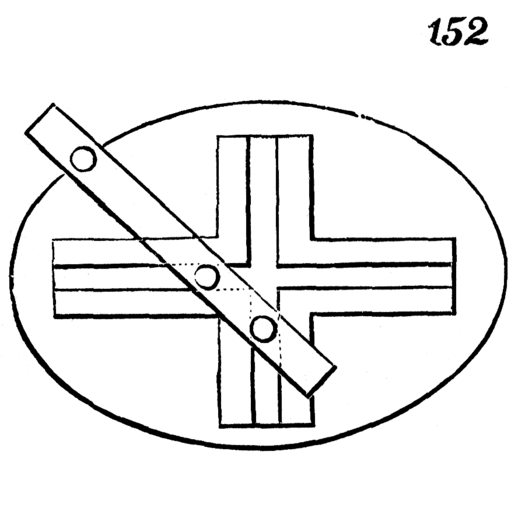
152. An ellipsograph. The traverse bar (shown in an oblique position) carries two studs which slide in the grooves of the cross-piece. By turning the traverse bar an attached pencil is made to describe an ellipse by the rectilinear movement of the studs in the grooves.