Movement No. 149 converts uniform circular motion into multiple alternating rectilinear motions using an array of cams acting on levers. A rotating shaft carries multiple cams, each positioned at different angular phases around the shaft. As the shaft turns, each cam lobe contacts its corresponding lever in sequence, pushing one end of the lever down. The other end of each lever is connected to a rod, which is thereby driven in an alternating rectilinear motion — rising when the cam lobe passes and falling back when the cam’s low section comes around. By staggering the angular positions of the cams on the shaft, the rods can be made to move in a timed sequence — one after another — rather than all simultaneously. This phased, multi-rod actuation is widely used in engine valve trains, textile machinery, automatic sorting equipment, and any system requiring multiple coordinated linear outputs from a single rotating drive shaft.
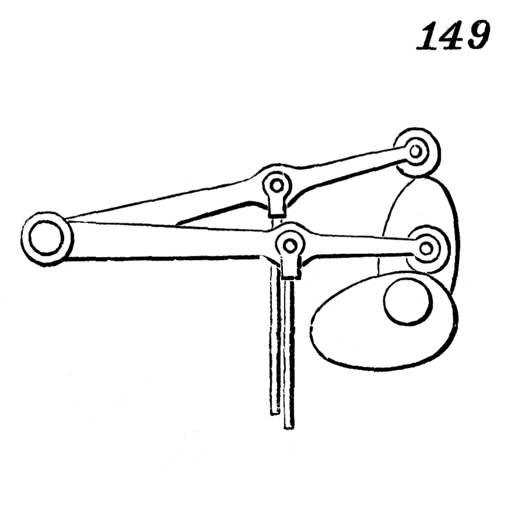
149. Uniform circular converted, by the cams acting upon the levers, into alternating rectilinear motions of the attached rods.