Movement No. 148 demonstrates how continuous circular motion of a pair of meshing spur-gears produces an alternating circular motion output through a crank-and-rod linkage attached to the larger gear. A small driver gear rotates continuously in one direction. It meshes with a larger gear, causing it to rotate continuously in the opposite direction. A crank arm is attached to the larger gear, with both ends pivoting freely. One end is pinned to the larger gear and revolves with it, while the other end connects to a rod whose opposite end is pivoted at a fixed point on the frame. As the larger gear rotates continuously, the crank pin traces a full circular path around the gear’s center. However, because the rod’s far end is anchored to the frame, the rod is constrained to swing back and forth in an arc — producing the alternating circular motion described. A circular guide track fixed to the larger gear constrains the crank pin’s shaft, ensuring stable and consistent motion throughout each revolution. This arrangement is commonly used to convert continuous rotary input into oscillating output motion, with applications in engines, looms, presses, and mechanical linkage systems.
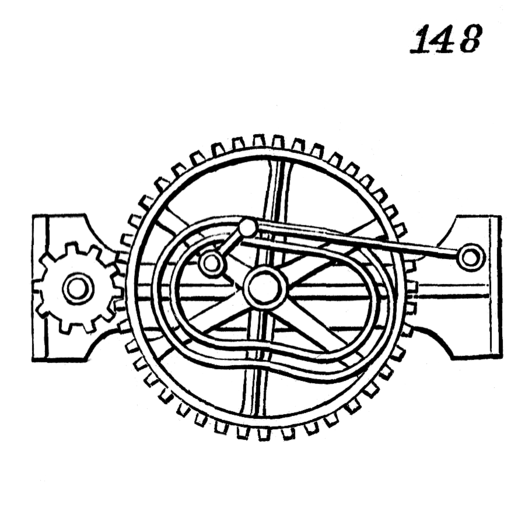
148. Continuous circular motion of the spur-gears produces alternate circular motion of the crank attached to the larger gear.