Movement No. 147 demonstrates a centrifugal steam engine governor that uses air-resistance fans, friction-rollers, and inclined planes to automatically regulate engine speed. The center shaft rotates and drives two circular inclined planes fixed to it. A cross-head sits loosely on the shaft, carrying fans (wings) that resist air and two friction-rollers that rest on the inclined planes. At low speeds, the inclined planes drag the cross-head around with them via the rollers. As engine speed increases, air resistance on the fans tends to slow the cross-head relative to the shaft — causing the friction-rollers to climb up the inclined planes, which raises the cross-head vertically. A lever connected to the top of the cross-head translates this vertical rise into a closing action on the engine’s regulating valve, reducing steam flow and thus limiting further speed increase. When speed drops, the cross-head descends and the valve reopens — creating a self-regulating feedback loop that maintains stable engine speed automatically.
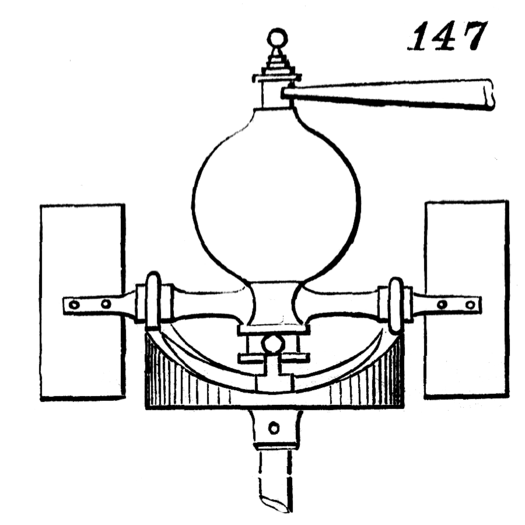
147. Steam engine governor. The operation is as follows:-On engine starting the spindle revolves and carries round the cross-head to which fans are attached, and on which are also fitted two friction-rollers which bear on two circular inclined planes attached securely to the center shaft, the cross-head being loose on the shaft. The cross-head is made heavy, or has a ball or other weight attached, and is driven by the circular inclined planes. As the speed of the center shaft increases, the resistance of the air to the wings tends to retard the rotation of the cross-head; the friction-rollers therefore run up the inclined planes and raise the cross-head, to the upper part of which is connected a lever operating upon the regulating-valve of the engine.