Movement No. 146 converts continuous rotary motion of a disk into reciprocating rectilinear motion of a yoke-bar using a crank-pin (wrist pin) riding in a shaped groove. A disk rotates continuously on its shaft, carrying a crank-pin on its face. This pin fits into a groove cut into a yoke-bar — a bar constrained to slide back and forth in a straight line. As the disk rotates, the crank-pin traces a circular path and slides within the groove, pushing the yoke-bar in one direction then the other. Unlike the Scotch yoke (No. 93) where the groove is straight, the groove in this mechanism can be shaped — curved or profiled — to modify the motion characteristics of the yoke-bar. By carefully designing the groove profile, the output motion can be made uniform in speed (constant velocity) throughout the stroke, rather than the sinusoidal variation produced by a straight slot. This flexibility makes the grooved yoke-bar mechanism highly adaptable for precision machinery requiring specific linear motion profiles.
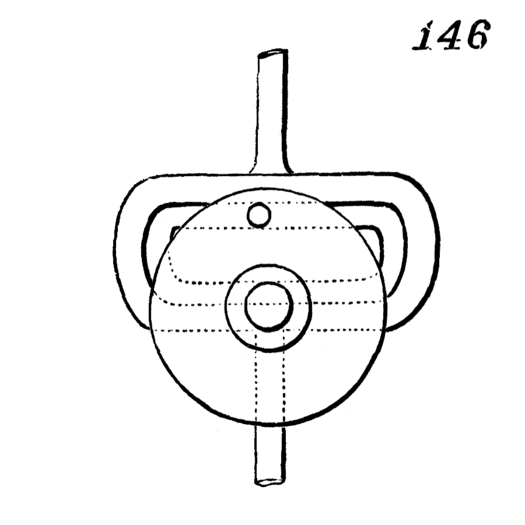
146. Continuous rotary motion of the disk produces reciprocating rectilinear motion of the yoke-bar, by means of the wrist or crank-pin on the disk working in the groove of the yoke. The groove may be so shaped as to obtain a uniform reciprocating rectilinear motion.