Movement No. 143 converts continuous circular motion into alternating rectilinear motion through an ingenious worm, worm-wheel, and traversing frame arrangement. A pulley drives a worm-shaft. The worm is keyed to slide freely along the shaft while still rotating with it via a groove-and-key connection. The worm is mounted in a small traversing-frame that slides along a horizontal bar of the fixed frame. This traversing-frame also carries the toothed worm-wheel that meshes with the worm. A connecting-rod links the fixed frame on one end to a wrist pin on the rotating worm-wheel on the other. As the worm-shaft turns, it drives the worm-wheel to rotate. The rotating worm-wheel, constrained by the connecting-rod attached to the fixed frame, cannot simply spin in place — instead, the entire traversing-frame is pushed to slide back and forth along the horizontal bar, producing smooth alternating rectilinear motion. The worm slides freely along the shaft to accommodate this traversing motion throughout the cycle.
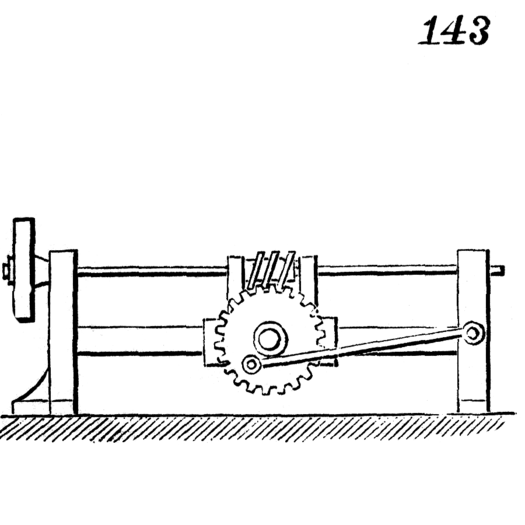
143. Circular motion into alternate rectilinear motion. Motion is transmitted through pulley at the left upon the worm-shaft. Worm slides upon shaft, but is made to turn with it by means of a groove cut in shaft, and a key in hub of worm. Worm is carried by a small traversing-frame, which slides upon a horizontal bar of the fixed frame, and the traversing-frame also carries the toothed wheel into which the worm gears. One end of a connecting-rod is attached to fixed frame at the right and the other end to a wrist secured in toothed wheel. On turning worm-shaft, rotary motion is transmitted by worm to wheel, which, as it revolves, is forced by connecting-rod to make an alternating traverse motion.