Movement No. 139 converts continuous rotary motion of a pinion into reciprocating rectilinear motion of a rectangular frame, using a floating internal rack as the intermediate element. The rectangular frame slides horizontally in fixed guides. Inside the frame, an internal rack is free to float vertically for a limited distance — it can shift up or down just enough to allow the continuously rotating pinion to engage either the upper teeth or the lower teeth of the rack. When the pinion drives the rack in one direction and the frame reaches the end of its stroke, the rack floats to the opposite side under the reaction force, bringing the other set of teeth into mesh with the pinion. The pinion then drives the frame back in the reverse direction. This automatic switching of rack engagement at each end of the stroke produces smooth, self-reversing reciprocating motion from a single continuously rotating pinion — without cams, levers, or additional mechanisms.
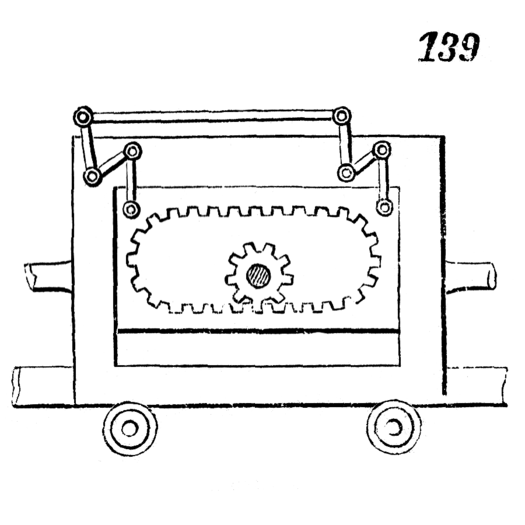
139. The internal rack, carried by the rectangular frame, is free to slide up and down within it for a certain distance, so that the pinion can gear with either side of the rack. Continuous circular motion of the pinion is made to produce reciprocating rectilinear motion of rectangular frame.