Movement No. 136 demonstrates a versatile cam-wheel mechanism in which the rim of a rotating wheel is shaped into teeth or any desired profile to drive a follower rod in alternating rectilinear motion. As the cam-wheel rotates, a rod pressed constantly against its rim rises and falls in response to the changing profile of the rim — advancing when a tooth or raised section passes, and retreating when a valley or lower section comes around. A spring or weight keeps the rod in constant contact with the rim at all times. The key feature of this mechanism is its adaptability: by changing the tooth shape or rim profile — making teeth taller, wider, more gradual, or sharper — the character of the rod’s reciprocating motion can be freely customized, including its speed, stroke length, dwell time, and acceleration profile. This programmable motion principle is the foundation of modern cam-follower systems used in internal combustion engine valve timing, automatic machinery, and precision instruments.
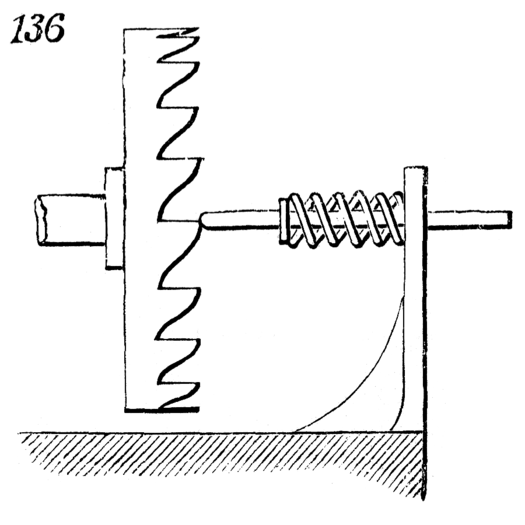
136. A cam-wheel-of which a side view is shown-has its rim formed into teeth, or made of any profile form desired. The rod to the right is made to press constantly against the teeth or edge of the rim. On turning the wheel, alternate rectilinear motion is communicated to the rod. The character of this motion may be varied by altering the shape of the teeth or profile of the edge of the rim of the wheel.