Movement No. 132 demonstrates a powerful press mechanism that uses oblique bars between two disks to generate large downward force on a platen. The upper disk is fixed against vertical movement but is free to rotate, driven by a horizontal lever arm. Two bars pass through holes in both the upper and lower disks at an oblique angle when the press is at rest. When the lever rotates the upper disk, the bars — constrained by the holes in both disks — are forced to straighten from their oblique positions toward vertical. As the bars approach perpendicular, they push the lower disk forcefully downward, pressing the platen against the workpiece with great mechanical advantage. This toggle-like action multiplies the input force enormously near the point of maximum pressure, since a small rotation produces a large downward displacement when the bars are nearly vertical. This mechanism was used in printing presses, coining presses, and other applications requiring high platen force from a modest rotary input.
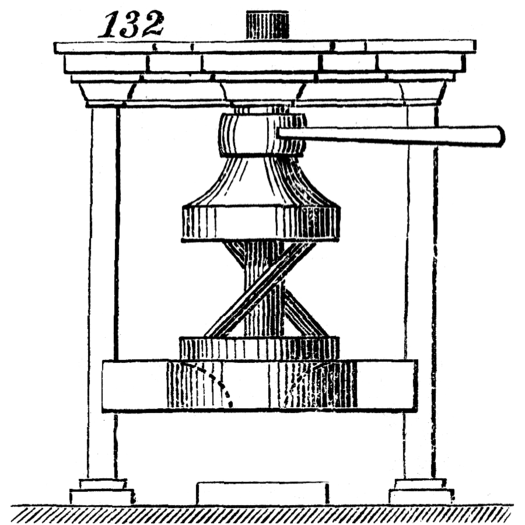
132. This is a motion which has been used in presses to produce the necessary pressure upon the platen. Horizontal motion is given to the arm of the lever which turns the upper disk. Between the top and bottom disks are two bars which enter holes in the disks. These bars are in oblique positions, as shown in the drawing, when the press is not in operation; but when the top disk is made to rotate, the bars move toward perpendicular positions and force the lower disk down. The top disk must be firmly secured in a stationary position, except as to its revolution.