Movement No. 129 demonstrates the Chinese windlass — a classic differential mechanism that shares the same underlying principle as the micrometer screw (No. 111). The windlass barrel consists of two cylinders of different diameters joined on the same axis. A single rope or chain winds around both sections: one end winds onto the larger diameter barrel while the other end unwinds from the smaller diameter barrel simultaneously as the windlass is turned. A movable pulley or block hangs in the loop of rope between the two barrel sections. With each full revolution of the windlass, the larger barrel winds in more rope than the smaller barrel pays out — but the net rise of the pulley is only half the difference between the two circumferences. This differential action provides an enormous mechanical advantage, allowing very heavy loads to be lifted with minimal effort. The Chinese windlass is the mechanical ancestor of the modern differential chain hoist.
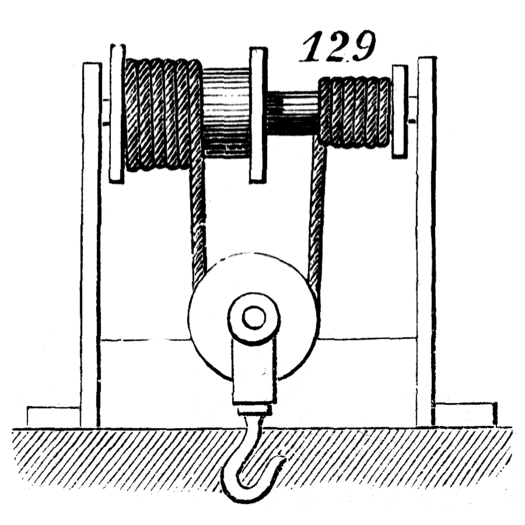
129. Chinese windlass. This embraces the same principles as the micrometer screw 111. The movement of the pulley in every revolution of the windlass is equal to half the difference between the larger and smaller circumferences of the windlass barrel.