Movement No. 127 demonstrates a dual-rack pump drive mechanism used in air pumps. A lever is fixed to the same shaft as a spur-gear positioned between two vertical racks, one on each side. When the lever is vibrated back and forth, it rotates the spur-gear, which simultaneously drives both racks in opposite directions — as one rack rises, the other descends. Each rack is connected to the piston of a separate pump cylinder. This opposing action means that one pump is always on its compression stroke while the other is on its intake stroke, producing a nearly continuous and balanced pumping action with minimal dead spots. The symmetrical arrangement also balances the forces on the central shaft, reducing wear and vibration. This efficient dual-piston design was widely employed in early air pumps and hydraulic machinery where continuous, smooth fluid displacement was essential.
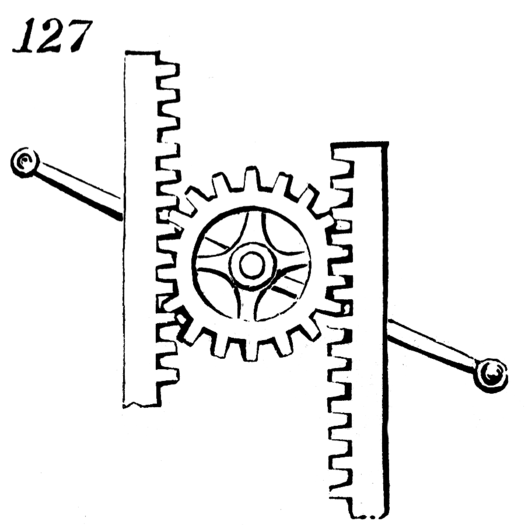
127. Motion used in air-pumps. On vibrating the lever fixed on the same shaft with the spur-gear, reciprocating rectilinear motion is imparted to the racks on each side, which are attached to the pistons of two pumps, one rack always ascending while the other is descending.