Movement No. 126 demonstrates the bell-crank lever — one of the simplest yet most universally useful mechanisms in all of engineering. A bell-crank lever is an L-shaped or angled lever that pivots about a fixed fulcrum at its corner. A force or motion applied to one arm of the lever is transmitted to the other arm at a changed direction — typically at 90 degrees, though other angles are possible. When a push or pull is applied to the end of one arm, the other arm moves perpendicularly, effectively redirecting the force without any loss of mechanical principle. The mechanical advantage can also be varied by changing the relative lengths of the two arms. Bell-crank levers are found in countless applications including bicycle brakes, valve linkages, steering mechanisms, door latches, and industrial control systems — wherever a change in the direction of motion or force transmission is needed in a compact and reliable way.
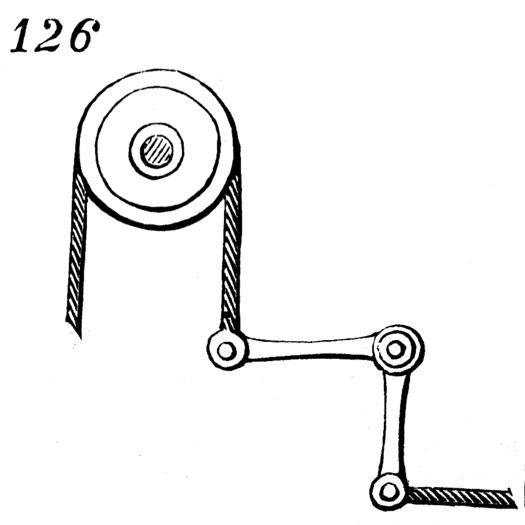
126. A bell-crank lever, used for changing the direction of any force.