Movement No. 124 demonstrates the fiddle drill — one of humanity’s oldest tools — which converts the reciprocating rectilinear motion of a bow into alternating rotary motion of a drill bit. A flexible string or cord is attached to both ends of a rigid bow and wound once around a pulley fixed to the drill spindle. As the bow is pushed forward, the string unwinds from one side of the pulley and rotates the spindle in one direction, driving the drill bit into the material. As the bow is pulled back, the string winds in the opposite direction and rotates the spindle in reverse. A downward pressure applied to the top cap of the drill keeps the bit pressed against the workpiece throughout both strokes, allowing cutting to occur in both directions. This ancient mechanism, used for thousands of years for drilling and fire-starting, is a beautiful example of converting linear motion into rotation with the simplest possible components.
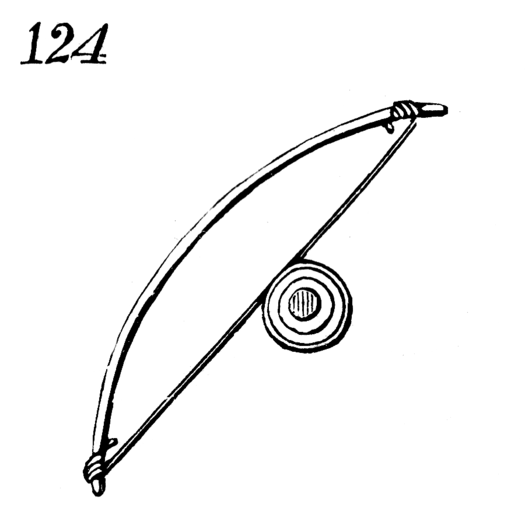
124. Fiddle drill. Reciprocating rectilinear motion of the bow, the string of which passes around the pulley on the spindle carrying the drill, producing alternating rotary motion of the drill.