Movement No. 122 demonstrates how two meshing spur-gears, each fitted with a crank-wrist (crank pin), work together to produce a variable alternating traverse of a horizontal bar. The two spur-gears rotate in opposite directions at the same speed due to their meshing. Each gear carries a crank-wrist pin that is connected to the horizontal bar. Because the two crank-wrists can be set at different angular positions relative to each other, the combined effect of their two circular motions on the bar produces a traverse motion that varies in speed and stroke length throughout the cycle — unlike a simple single-crank arrangement that produces uniform sinusoidal motion. By adjusting the relative phase angle of the two crank-wrists, different traverse profiles can be achieved, making this mechanism useful for generating complex, non-uniform reciprocating motions in weaving looms, specialized feed mechanisms, and experimental machinery.
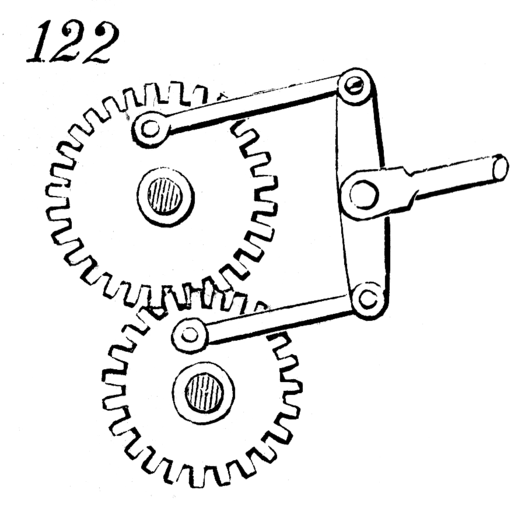
122. The rotation of the two spur-gears, with crank-wrists attached, produces a variable alternating traverse of the horizontal bar.