Movement No. 118 demonstrates an ingenious mechanism for doubling the stroke length of a piston-rod or crank throw using a rack-and-pinion arrangement. A pinion is mounted on a spindle attached to a connecting-rod, and meshes with a fixed lower rack on one side. A free upper rack, carried by a guide-rod, meshes with the opposite side of the same pinion and is free to slide back and forth. As the connecting-rod moves through its full stroke, it carries the pinion along the fixed bottom rack. Because the bottom rack is stationary, the pinion is forced to rotate as it travels. This rotation then drives the upper rack — but since the upper rack moves both from the pinion’s bodily translation and from its rotation, it travels exactly twice the distance of the connecting-rod’s stroke. This elegant doubling mechanism is highly useful wherever a longer linear stroke is needed without increasing the crank radius or cylinder length.
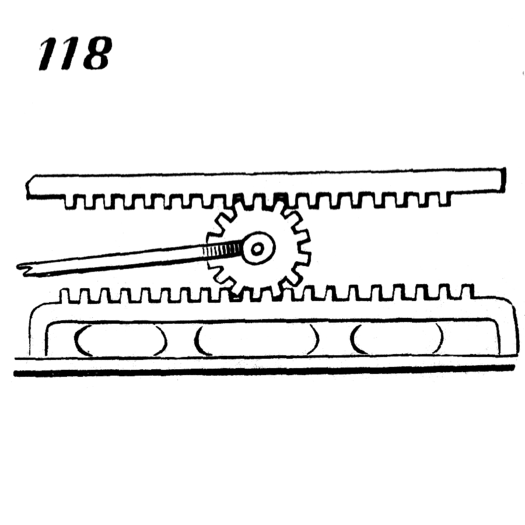
118. A mode of doubling the length of stroke of a piston-rod, or the throw of a crank. A pinion revolving on a spindle attached to the connecting-rod or pitman is in gear with a fixed rack. Another rack carried by a guide-rod above, and in gear with the opposite side of the pinion, is free to traverse backward and forward. Now, as the connecting-rod communicates to the pinion the full length of stroke, it would cause the top rack to traverse the same distance, if the bottom rack was alike movable; but as the latter is fixed, the pinion is made to rotate, and consequently the top rack travels double the distance.