Movement No. 116 is a clever substitute for the crank, converting reciprocating rectilinear motion into uniform rotary motion using a double rack and ratchet-pinion system. A frame carries two racks positioned in different planes. Each rack meshes with its own pinion, and both pinions run loosely on the output shaft. Outside each pinion, a ratchet-wheel is fixed to the shaft — one with teeth pointing in one direction, the other with teeth pointing the opposite way. Each pinion carries a pawl that engages its corresponding ratchet-wheel. When the frame moves in one direction, one pinion’s pawl engages its ratchet and drives the shaft forward, while the other pinion spins freely. When the frame reverses, the roles switch — the second pinion’s pawl engages and drives the shaft in the same rotary direction. The result is continuous, unidirectional rotation of the shaft from a back-and-forth linear input, functioning as a highly effective crank substitute.
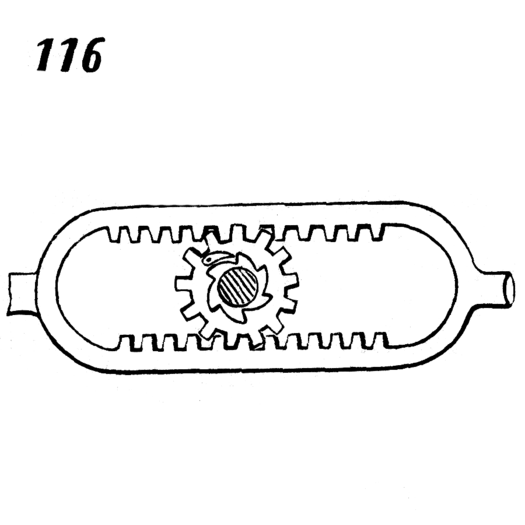
116. A substitute for the crank. Reciprocating rectilinear motion of the frame carrying the double rack produces a uniform rotary motion of the pinion-shaft. A separate pinion is used for each rack, the two racks being in different planes. Both pinions are loose on the shaft. A ratchet-wheel is fast on the shaft outside of each pinion, and a pawl attached to the pinion to engage in it, one ratchet-wheel having its teeth set in one direction and the other having its teeth set in the opposite direction. When the racks move one way, one pinion turns the shaft by means of its pawl and ratchet; and when the racks move the opposite way, the other pinion acts in the same way, one pinion always turning loosely on the shaft