Movement No. 113 demonstrates the rack and pinion — one of the most classic and widely used mechanisms for converting between rotary and rectilinear motion. A pinion, which is a small circular gear, meshes with a rack — a straight bar with teeth cut along its length. When the pinion rotates, its teeth engage the rack teeth and drive the rack in a straight line, converting rotary motion into rectilinear motion. Conversely, pushing the rack linearly causes the pinion to rotate, converting rectilinear motion into rotary motion. The relationship between rotation and linear displacement is precise and proportional: each full revolution of the pinion advances the rack by a distance equal to the pinion’s circumference. This versatile mechanism is found everywhere in engineering — from steering systems in automobiles and elevators to CNC machine tool drives, clocks, and camera focusing mechanisms.
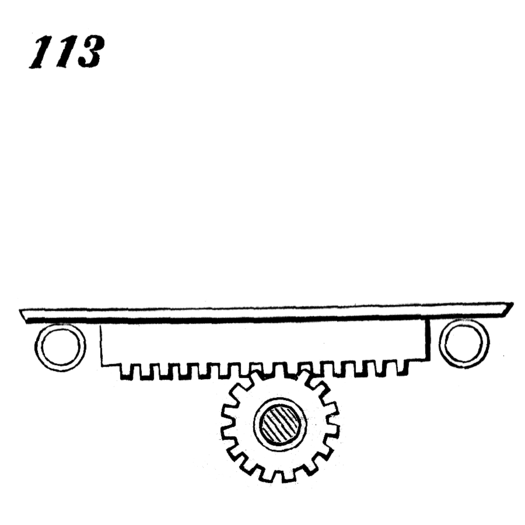
113. Circular into rectilinear motion, or vice versa, by means of rack and pinion.