Movement No. 112 demonstrates the Persian drill — an ancient and ingenious hand tool that converts reciprocating linear motion into alternating rotary motion. The drill stock is cut with a very coarse, fast-pitch helical thread and is free to rotate, supported at the top by a head that rests against the operator’s body. A button or nut in the middle of the stock is gripped firmly in the hand. When the hand rapidly slides the nut up and down along the threaded stock, the steep thread converts this linear push-pull motion into rapid rotation of the drill bit — first in one direction, then the other, alternating with each stroke. The two-directional spinning action, combined with a downward pressure, allows the drill bit to cut effectively into material. This simple mechanism represents one of humanity’s earliest examples of converting reciprocating motion into rotation, predating modern drill designs by centuries.
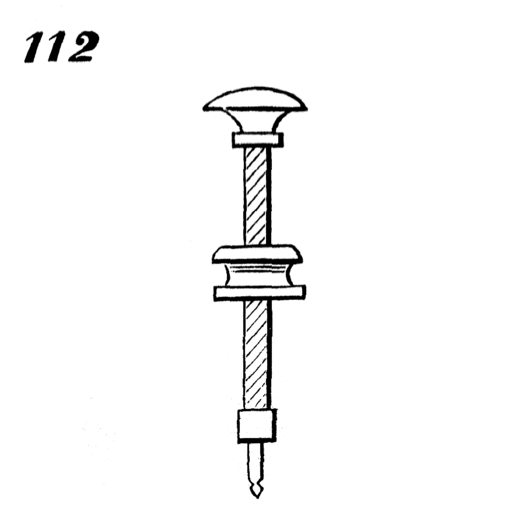
112. Persian drill. The stock of the drill has a very quick thread cut upon it and revolves freely, supported by the head at the top, which rests against the body. The button or nut shown on the middle of the screw is held firm in the hand, and pulled quickly up and down the stock, thus causing it to revolve to the right and left alternately.