Movement No. 111 demonstrates the differential micrometer screw — a remarkably precise mechanism capable of generating extremely fine linear motion and great mechanical force. The device consists of two concentric screws: an outer hollow screw and an inner smaller screw, each cut with threads of different pitch and running in opposite directions. As the outer hollow screw makes one full revolution inside its fixed nut, it advances by its thread pitch. Simultaneously, the inner screw — being threaded in the opposite direction — moves back relative to the outer screw by its own pitch. The net linear displacement of the inner nut or die is therefore only the difference between the two pitches per revolution, which can be made extremely small. This differential action multiplies mechanical advantage enormously, allowing very fine positional adjustments and large clamping or pressing forces from modest rotary input. The principle is the basis of the precision micrometer gauge used in engineering measurement.
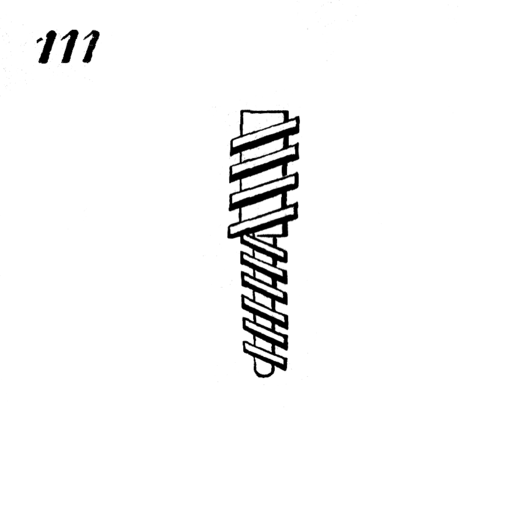
111. Micrometer screw. Great power can be obtained by this device. The threads are made of different pitch and run in different directions, consequently a die or nut fitted to the inner and smaller screw would traverse only the length of the difference between the pitches for every revolution of the outside hollow screw in a nut.