Movement No. 109 demonstrates the screw-cutting lathe feed mechanism — one of the most important inventions in precision manufacturing history. A lead screw on the left rotates continuously, driving a cutter in a perfectly uniform rectilinear motion along the workpiece. As the cutter advances at a rate precisely synchronized with the rotation of the workpiece, it cuts a helical thread into the surface. The key feature of this mechanism is its adjustability: by swapping the change gears at the end of the frame for wheels of different sizes, the ratio between the lead screw speed and the workpiece rotation can be altered, allowing threads of different pitches to be cut accurately on the same machine. This principle of gear-controlled thread cutting, pioneered by engineers such as Henry Maudslay, became the foundation of the modern precision lathe and interchangeable parts manufacturing.
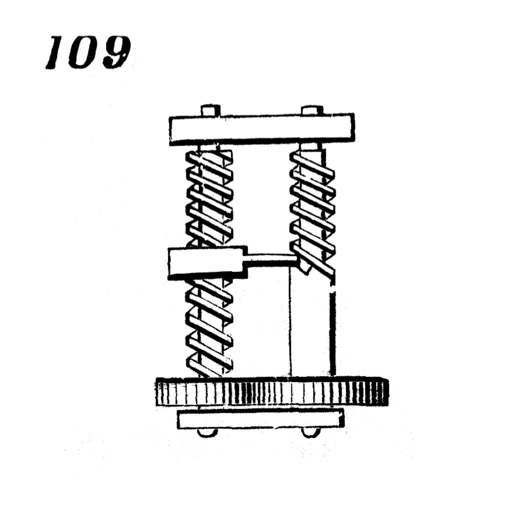
109. The rotation of the screw at the left-hand side produces a uniform rectilinear movement of a cutter which cuts another screw thread. The pitch of the screw to be cut may be varied by changing the sizes of the wheels at the end of the frame.