Movement No. 103 demonstrates how the rotation of a screw produces precise rectilinear motion of a slide. A threaded screw is mounted between fixed supports and rotated about its own axis. A slide or carriage fitted with a matching threaded nut is engaged onto the screw. As the screw turns, the slide is unable to rotate — being constrained by its guide rails — and is therefore driven linearly along the length of the screw. Each full revolution of the screw advances the slide by exactly one thread pitch, making this an exceptionally precise and controllable linear motion mechanism. This principle is the foundation of the lead screw in metal lathes, milling machines, and CNC machine tools, as well as linear actuators and precision positioning stages used throughout modern manufacturing and engineering.
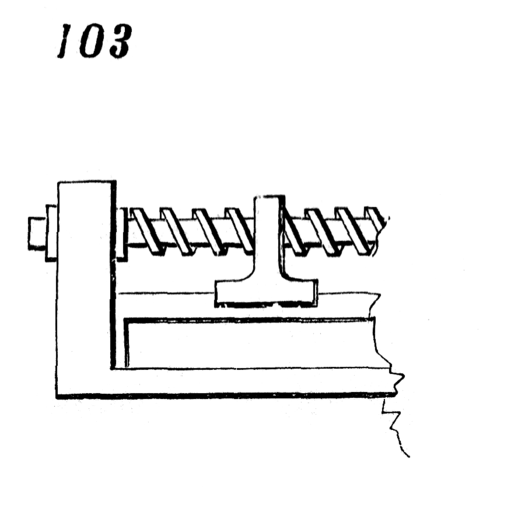
103. Rectilinear motion of slide produced by the rotation of screw.