Movement No. 102 demonstrates one of the most fundamental mechanisms in all of engineering — the common screw bolt and nut. When the bolt is rotated, its helical thread engages the matching thread of the nut, converting continuous circular motion into controlled rectilinear motion along the bolt’s axis. With each full revolution of the bolt, the nut advances a linear distance equal to the thread pitch. This simple yet powerful principle allows rotary effort to be transformed into precise linear displacement and also provides a significant mechanical advantage, enabling large axial forces to be generated from relatively small rotary inputs. The screw-and-nut mechanism is the foundation of clamps, vises, jacks, lead screws in machine tools, and countless fastening and positioning devices throughout engineering and manufacturing.
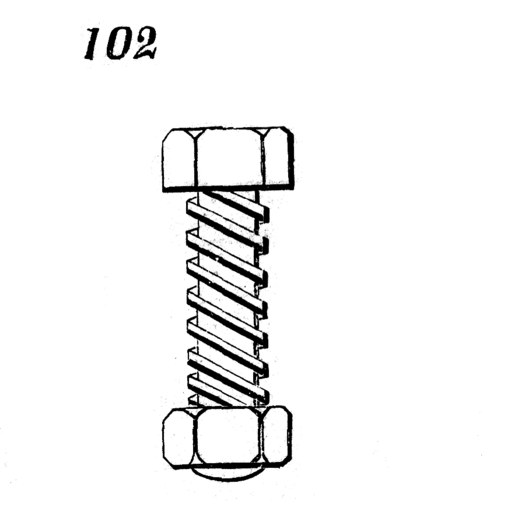
102. Common screw bolt and nut; rectilinear motion obtained from circular motion.