Movement No. 96 features a heart-shaped cam — a specially designed cam profile that converts continuous rotary motion into perfectly uniform reciprocating rectilinear motion. Unlike a circular eccentric or ordinary cam which produces sinusoidal output, the heart cam is geometrically constructed so that a follower rod advances and retreats at a constant linear speed throughout the entire rotation. The cam profile is derived by dividing the traverse length into equal parts, drawing concentric circles through those points from the center, then dividing the outer circle into twice as many equal angular divisions and connecting them to the center. The cam curve passes through all the intersections of these radial lines and concentric circles. This uniform motion property makes the heart cam invaluable in textile machinery, winding mechanisms, and any application requiring constant-speed linear feed.
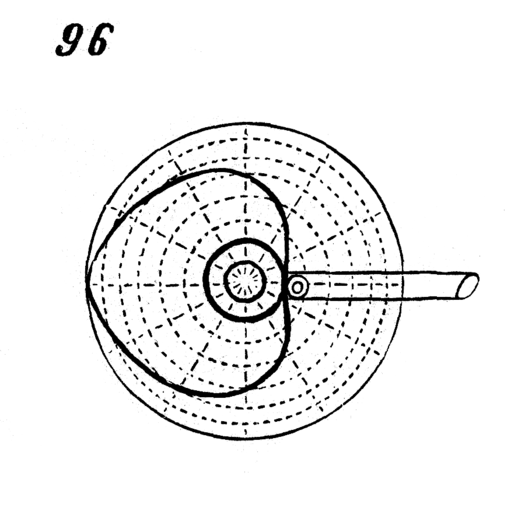
96. A heart-cam. Uniform traversing motion is imparted to the horizontal bar by the rotation of the heart-shaped cam. The dotted lines show the mode of striking out the curve of the cam. The length of traverse is divided into any number of parts; and from the center a series of concentric circles are described through these points. The outside circle is then divided into double the number of these divisions, and lines drawn to the center. The curve is then drawn through the intersections of the concentric circles and the radiating lines.