Movement No. 92 demonstrates the ordinary crank mechanism — one of the most fundamental and widely used devices in all of mechanical engineering. A crank is an arm fixed at a right angle to a rotating shaft. As the shaft turns, the crank pin traces a circular path, and through a connecting rod, this rotary motion is converted into reciprocating rectilinear motion of a piston or slider. Conversely, a reciprocating force applied to the connecting rod can drive the crank and rotate the shaft. This simple yet powerful mechanism is the foundation of steam engines, internal combustion engines, pumps, presses, and countless other machines that rely on converting between rotation and linear motion.
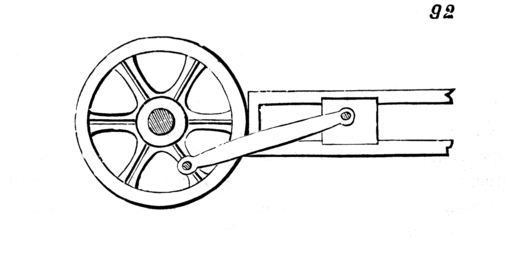
92. Ordinary crank motion.