Movement No. 83 converts reciprocating rectilinear motion into a nearly continuous rotary motion using a pair of ratchet-toothed arcs. A rod (A) moves back and forth, rocking the rock-shaft (B). Two toothed arcs (C) are fixed to this rock-shaft, positioned on opposite sides of the ratchet-wheel (D), with their teeth set in opposing directions. As the rock-shaft oscillates, one arc engages the ratchet-wheel and advances it, while the other arc slides over the teeth in the return direction. Springs allow each arc to rise and slip over the wheel teeth on the idle stroke. The opposing tooth directions ensure that the wheel is driven forward on both strokes, producing smooth and nearly uninterrupted rotation.
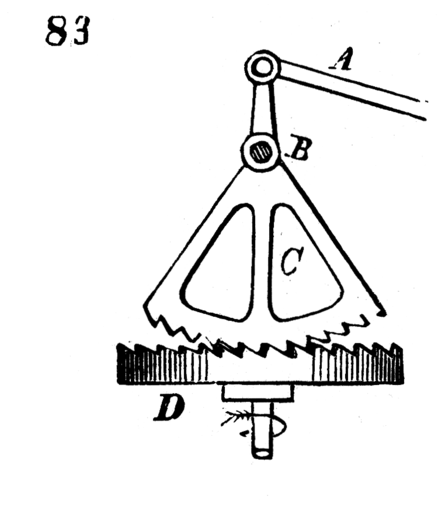
83. A nearly continuous rotary motion is given to the wheel, D, by two ratchet-toothed arcs, C, one operating on each side of the ratchet-wheel, D. These arcs (only one of which is shown) are fast on the same rock-shaft, B, and have their teeth set opposite ways. The rock-shaft Is worked by giving a reciprocating rectilinear motion to the rod, A. The arcs should have springs applied to them, so that each may be capable of rising to allow its teeth to slide over those of the wheel in moving one way.