Movement No. 82 converts the alternating up-and-down motion of two treadles into a nearly continuous rotary motion of a ratchet wheel. Each treadle (D) is connected by a chain or strap that passes over a pulley (C), so that as one treadle is pressed down, the other is lifted up. This alternating motion drives a pair of vibrating arms (B), each fitted with a pawl that engages the ratchet-wheel (A). The two pawls act in turn, ensuring that the ratchet wheel receives an impulse on every stroke and rotates with minimal interruption. This mechanism was widely used in foot-powered machines such as early lathes, grindstones, and sewing machines.
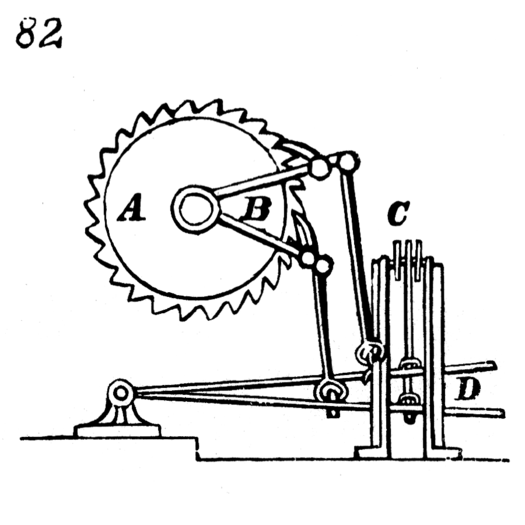
82. On motion being given to the two treadles, D, a nearly continuous motion is imparted, through the vibrating arms, B, and their attached pawls, to the ratchet-wheel, A. A chain or strap attached to each treadle passes over the pulley, C, and as one treadle is depressed the other is raised.