Movement No. 79 converts reciprocating rectilinear motion into a nearly continuous rotary motion. A rod (B) moves back and forth in a straight line, driving a pair of vibrating radial arms (C, C). Pawls mounted at the tips of these arms engage a ratchet-faced wheel (A), pushing it forward on each stroke. Because the two radial arms are offset from each other, one pawl is always in contact with the ratchet, ensuring smooth and nearly uninterrupted rotation. This mechanism is an effective solution for converting linear input — such as from a piston or hand lever — into controlled one-directional rotation.
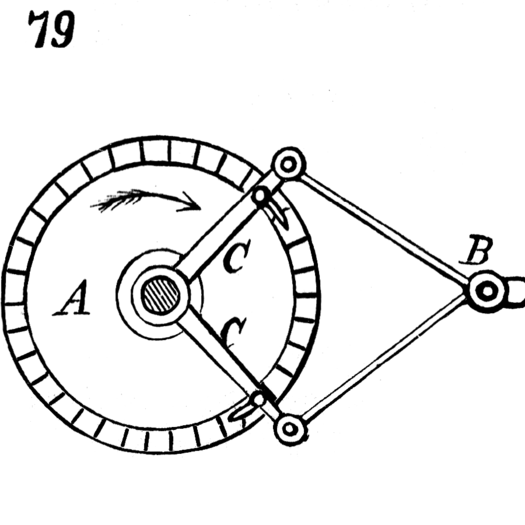
79. Reciprocating rectilinear motion of the rod, B, produces a nearly continuous rotary movement of the ratchet-faced wheel, A, by the pawls attached to the extremities of the vibrating radial arms, C, C.