This animation demonstrates Movement No. 77 from “507 Mechanical Movements” — a dual-pawl ratchet mechanism in which a vibrating lever produces an almost continuous rotary motion. The lever C rocks back and forth about its fixed fulcrum A. Mounted on the lever are two pawls positioned to engage the teeth of the ratchet wheel B from opposite sides or at offset positions. The key feature of this mechanism is that the two pawls are arranged to act alternately — when the lever swings in one direction, the first pawl engages and advances the ratchet wheel by a set number of teeth; when the lever swings back in the other direction, the second pawl takes over and advances the wheel again by the same increment. Because both pawls drive the wheel in the same rotational direction on each half-stroke of the lever, the ratchet wheel B receives an advancing impulse on both the forward and return strokes. This means the wheel is driven twice per full oscillation of the lever, effectively doubling the frequency of advancement compared to a single-pawl arrangement and producing what the original text describes as “almost a continuous movement.” The slight intermittency that remains comes from the brief moment between one pawl disengaging and the next engaging. By carefully spacing the two pawls relative to the tooth pitch of the ratchet wheel, this dwell period can be minimized, resulting in a very smooth and near-continuous output rotation from an oscillating input. This mechanism was valued in applications where smoother output was needed from a reciprocating or oscillating input, such as in clockwork, weaving machinery, and mechanical calculating devices, where single-pawl ratchets produced too much jerkiness or too slow an output rate.
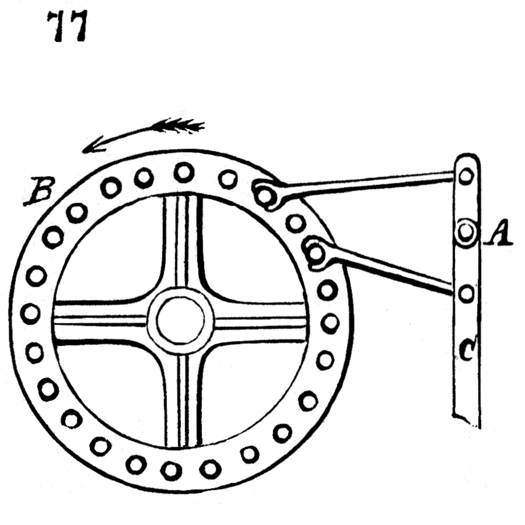
77. The vibration of the lever, C, on the center or fulcrum, A, produces a rotary movement of the wheel, B, by means of the two pawls, which act alternately. This is almost a continuous movement.