This animation demonstrates Movement No. 76 from “507 Mechanical Movements” — a mechanical revolution counting mechanism driven by a stud, tappet, and ratchet wheel. The large driving wheel rotates continuously, carrying with it a single stud D fixed to its face. Mounted nearby on a fixed pivot C is the tappet B — a lever arm that is free to rock about its pivot point. One end of the tappet is positioned in the path of the rotating stud D, while the other end rests lightly against the teeth of the ratchet wheel A. Once per revolution of the large wheel, the stud D strikes the first end of the tappet B, causing it to rock on its pivot C. This rocking motion lifts the opposite end of the tappet upward, engaging a tooth of the ratchet wheel A and advancing it by exactly one tooth. The ratchet wheel therefore advances by one tooth increment for every complete revolution of the large driving wheel — making it a precise mechanical counter of revolutions. After the stud D passes and no longer presses against the tappet, the tappet returns to its original resting position under its own weight due to gravity. The end of the tappet that contacts the ratchet wheel is jointed — hinged — so that on the return stroke it can fold back and slide freely over the tops of the ratchet teeth without disturbing the wheel’s position. This jointed tip acts as a one-way driving pawl, ensuring motion is transmitted in one direction only. The simplicity and reliability of this mechanism made it highly suitable for use in mechanical counters, odometers, mill tallying devices, and industrial machinery where the number of rotations of a shaft needed to be recorded automatically and accurately without any external power source.
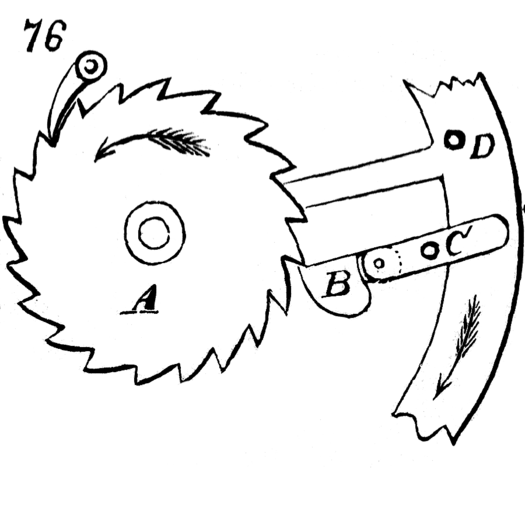
76. Is another contrivance for registering or counting revolutions. A tappet, B, supported on the fixed pivot, C, is struck at every revolution of the large wheel (partly represented) by a stud, D, attached to the said wheel. This causes the end of the tappet next the ratchet-wheel, A, to be lifted, and to turn the wheel the distance of one tooth. The tappet returns by its own weight to its original position after the stud, D, has passed, the end being jointed to permit it to pass the teeth of the ratchet-wheel.