This animation demonstrates Movement No. 73 from “507 Mechanical Movements” — a Spring-Actuated Ratchet Mechanism. A bent catch-spring B is fixed to the continuously rotating driving-wheel D. As D revolves, spring B passes beneath a fixed strong spring C, which deflects it downward into a tooth of the ratchet-wheel A, advancing it by one tooth per revolution. Once spring B clears spring C, it snaps back to its original position, and the ratchet-wheel A remains stationary until the next revolution of D. The fixed spring C also acts as a stop, preventing the ratchet-wheel from back-driving. This elegant mechanism converts continuous rotary motion into precise intermittent rotation using only spring elements — no rigid pawl required.
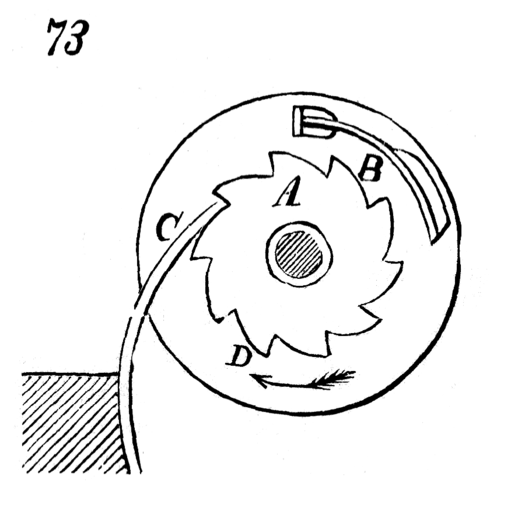
73. To the driving-wheel, D, is secured a bent spring, B; another spring, C, is attached to a fixed support. As the wheel, D, revolves, the spring, B, passes under the strong spring, C, which presses it into a tooth of the ratchet-wheel, A, which is thus made to rotate. The catch-spring, B, being released on its escape from the strong spring, C, allows the wheel, A, to remain at rest till D has made another revolution. The spring, C, serves as a stop.