Movement No. 71 presents the most sophisticated of the rim-and-stud intermittent motion family — using the inner circumference of the driving wheel’s rim as the locking surface, combined with two notches (upper and lower) to manage the entry and exit of studs, creating a smooth and precisely controlled intermittent advance. In this arrangement, the driving wheel B has a circular rim whose inner circumference (shown in dotted lines) acts as the locking surface. Two studs of the driven stud wheel C rest against this inner rim at any given moment, held firmly and unable to rotate by the rim’s curved interior surface. The tappet A projects from driving wheel B. Two notches are cut in the rim — one at the top and one at the bottom — positioned precisely relative to the tappet. As driving wheel B rotates, the tappet A strikes one of the studs resting against the inner rim, pushing the stud wheel C forward. As this happens, two simultaneous stud transitions occur through the notches: the stud immediately below the tappet’s target exits through the lower notch, leaving the rim’s enclosure, while a new stud from wheel C enters the rim’s enclosure through the upper notch. With the tappet’s push complete, the two studs now inside the rim rest against its inner circumference and are again locked. This dual-notch entry-and-exit system ensures that at every moment — whether the mechanism is advancing or locked — exactly two studs are always inside the rim, maintaining a balanced, stable, and symmetric locking force. The inner-rim locking geometry distributes the locking load across two contact points simultaneously, making this a stronger and more stable intermittent indexer than the single-surface designs of Movements 68, 69, and 70.
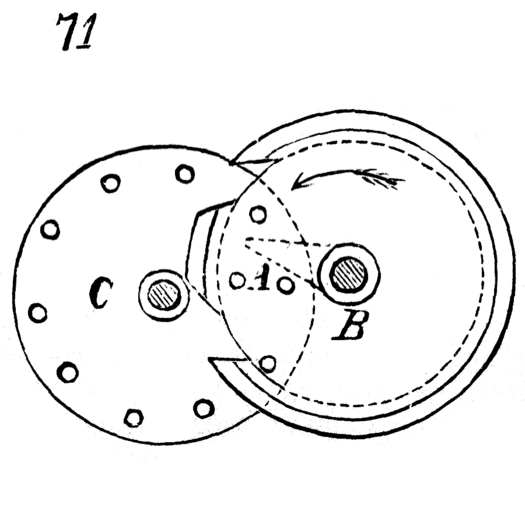
71. The inner circumference (shown by dotted lines) of the rim of the driving-wheel, B, serves as a lock against which two of the studs in the wheel, C, rest until the tappet, A, striking one of the studs, the next one below passes out from the guard-rim through the lower notch, and another stud enters the rim through the upper notch.