Movement No. 69 presents a close variation of the self-locking single-tooth intermittent mechanism introduced in Movement No. 68 — but with an important geometric difference that creates a distinct locking action. In both movements, a small driving wheel with a single tooth advances a larger driven wheel one step per revolution. However, while in No. 68 the driven wheel C had smooth concave hollows cut between its notches to receive the smooth body of the driving wheel, in No. 69 the driven wheel A has actual gear teeth around its circumference — and the locking is achieved by the smooth circular body of the small driving wheel B fitting snugly between these teeth. The small wheel B has a single tooth projecting from its otherwise smooth, circular body. As B rotates, its single tooth enters the tooth spaces of the larger wheel A and pushes one tooth forward — advancing wheel A by exactly one tooth-space per revolution of B. During the rest of B’s revolution, its smooth circular circumference enters the gap between two consecutive teeth of wheel A and nests there, physically blocking any further rotation of A. The tooth profile of wheel A and the circular radius of wheel B’s smooth body are matched precisely so that the fit is snug and secure — preventing any accidental movement of the driven wheel between advances. This arrangement differs from No. 68 in that the driven wheel carries conventional teeth rather than specially cut notches and hollows, making wheel A a standard gear wheel that can also mesh with other gears in the system. The mechanism is compact, elegant, and requires no separate detent or lock component — the geometry of the two wheels themselves provides complete intermittent advance and positive locking in a single integrated design.
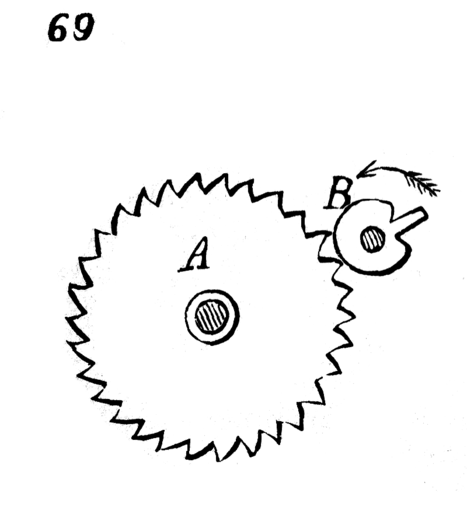
69. B, a small wheel with one tooth, is the driver, and the circumference entering between the teeth of the wheel, A, serves as a lock or stop while the tooth of the small wheel is out of operation.