Movement No. 65 presents a precise and elegant intermittent motion mechanism that advances the driven wheel one stud-space per revolution of the driving wheel — using a tappet, a stud wheel, and a lever-lock stop to ensure controlled, exact single-step indexing. The driving wheel C rotates continuously on the left, carrying tappet A fixed to its face — a projecting element that strikes the studs on the driven wheel. The driven wheel D has a series of equally spaced studs projecting from its face around its circumference. Each complete revolution of wheel C causes tappet A to strike one stud on wheel D, pushing it forward by exactly one stud-space — a precise fractional rotation of wheel D. The critical engineering challenge is preventing wheel D from over-rotating beyond one step — and this is where the lever-like stop comes in. A lever is pivoted on a fixed center between the two wheels. When tappet A strikes a stud on wheel D and pushes it, a notch cut in the periphery of driving wheel C aligns with one end of the lever — allowing that end of the lever to enter the notch and freeing the other end to lock between two studs of wheel D, preventing any further rotation. The instant tappet A finishes pushing the stud and leaves it, the notch on wheel C rotates away — its solid periphery presses on the lever’s free end and forces it back out from between the studs of D. This simultaneously prepares the lever to lock D again at the completion of the next tappet stroke. The result is a perfectly synchronized lock-advance-lock cycle: wheel D advances one precise step per revolution of wheel C, then is positively locked until the next advance.
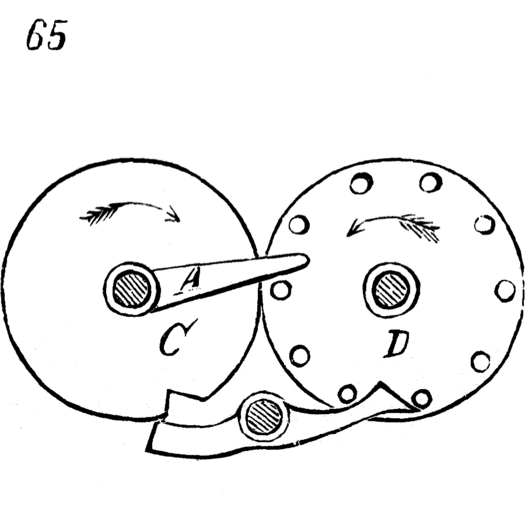
65. The left-hand disk or wheel, C, is the driving-wheel, upon which is fixed the tappet, A. The other disk or wheel, D, has a series of equidistant studs projecting from its face. Every rotation of the tappet acting upon one of the studs in the wheel, D, causes the latter wheel to move the distance of one stud. In order that this may not be exceeded, a lever-like stop is arranged on a fixed center. This stop operates in a notch cut in wheel, C, and at the instant tappet, A, strikes a stud, said notch faces the lever. As wheel, D, rotates, the end between studs is thrust out, and the other extremity enters the notch; but immediately on the tappet leaving stud, the lever is again forced up in front of next stud, and is there held by periphery of C pressing on its other end.