Movement No. 64 presents another ingenious jumping or snap-action intermittent motion mechanism — this time driven by a worm gear and powered by a specially shaped cam and spring combination. The driving shaft at the bottom carries a worm or endless screw that meshes with and continuously drives worm-gear B. Coaxial with the worm-gear shaft is a hollow shaft on which cam A is fixed. A critical detail of this hollow shaft is that a short section of it has been half cut away — creating a notch or recess that interacts with a pin fixed in the worm-gear shaft. The operating principle is as follows: the spring presses continuously against cam A, loading it. As the worm-gear shaft rotates, its pin contacts the notched section of the hollow shaft and pushes the hollow shaft — and with it cam A — along with the worm-gear’s rotation, against the spring pressure. This continues as long as the spring pressure direction keeps the hollow shaft pressed back against the driving pin. However, the peculiar shape of cam A is designed so that as the cam reaches a critical angular position, the direction of the spring’s pressure on the cam suddenly changes — from pushing against the cam’s motion to assisting it. At this tipping point, the cam and hollow shaft are suddenly released from the pin and the spring snaps the cam forward rapidly and independently, while the worm-gear continues its slow steady rotation. The cam snaps to a new resting position and waits there until the worm-gear’s pin catches up to it again, restarting the cycle. This produces a characteristic jumping snap-action output: a period of slow, pin-driven advance followed by a sudden rapid snap, repeating at every worm-gear rotation cycle.
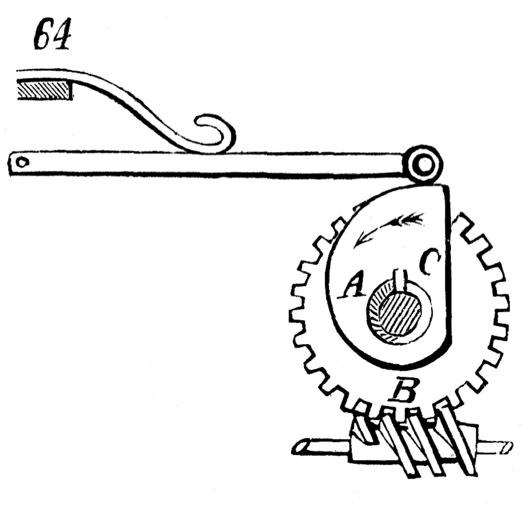
64. Another arrangement of jumping motion. Motion is communicated to worm-gear, B, by worm or endless screw at the bottom, which is fixed upon the driving-shaft. Upon the shaft carrying the worm-gear works another hollow shaft, on which is fixed cam, A. A short piece of this hollow shaft is half cut away. A pin fixed in worm-gear shaft turns hollow shaft and cam, the spring which presses on cam holding hollow shaft back against the pin until it arrives a little further than shown in the figure, when, the direction of the pressure being changed by the peculiar shape of cam, the latter falls down suddenly, independently of worm-wheel, and remains at rest till the pin overtakes it, when the same action is repeated.