Movement No. 61 presents one of the most mechanically sophisticated speed transmission systems in the 507 collection — a two-speed drive that combines belt drive, bevel gearing, and a friction-band braking element to produce both a simple direct speed and a double differential speed from the same input. Three pulleys are arranged on the lower shaft. The leftmost is a loose idler — neutral, transmitting nothing. The middle pulley is fast on the shaft and has a small bevel gear fixed to its hub. The rightmost pulley is also loose on the shaft but carries a transverse bevel gear on its side. A third bevel gear sits loose on the shaft and is held partially stationary by a weighted friction-band — a curb that allows it to slip slightly under sudden speed changes but otherwise holds it. When the belt is placed on the middle fast pulley, the shaft is driven directly and simply at the input belt speed — the bevel gears are not actively engaged in the drive path and the result is a straightforward single speed output. When the belt is shifted to the right-hand loose pulley, the transverse bevel gear on that pulley meshes with the small bevel gear on the fast middle pulley’s hub and also with the third friction-held bevel gear. Because the third bevel gear is held nearly stationary by the friction curb, the rotation of the right pulley’s bevel gear is forced to react against it — and through the differential bevel gear action, the shaft is driven at double the speed compared to the simple mode. The weighted friction-band on the third bevel gear acts as a smooth shock absorber, allowing gradual engagement and preventing sudden mechanical shock when the speed is changed.
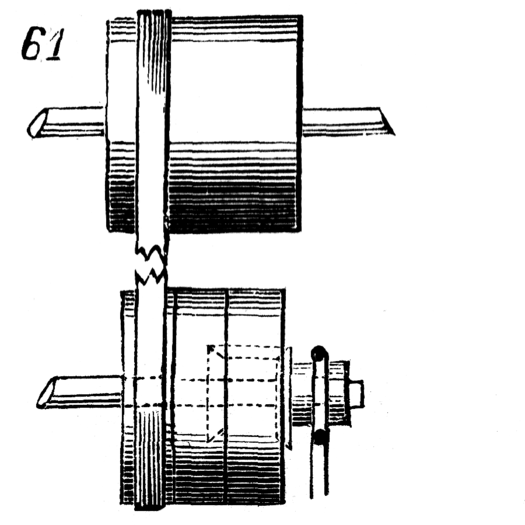
61. For transmitting two speeds, one a differential motion. The band is shown on a loose pulley on lower shaft. The middle pulley is fast on said shaft, and has a small bevel-gear secured to its hub. Pulley on the right, which, like that on the left, is loose on shaft, carries, transversely, another bevel-gear. A third bevel-gear, loose upon the shaft, is held by a friction-band which is weighted at the end. On moving band on middle pulley a simple motion is the result, but when it is moved to right-hand pulley a double speed is given to shaft. The friction-band or curb on the third bevel-gear is to allow it to slip a little on a sudden change of speed.